Another mock-up for Oxford.
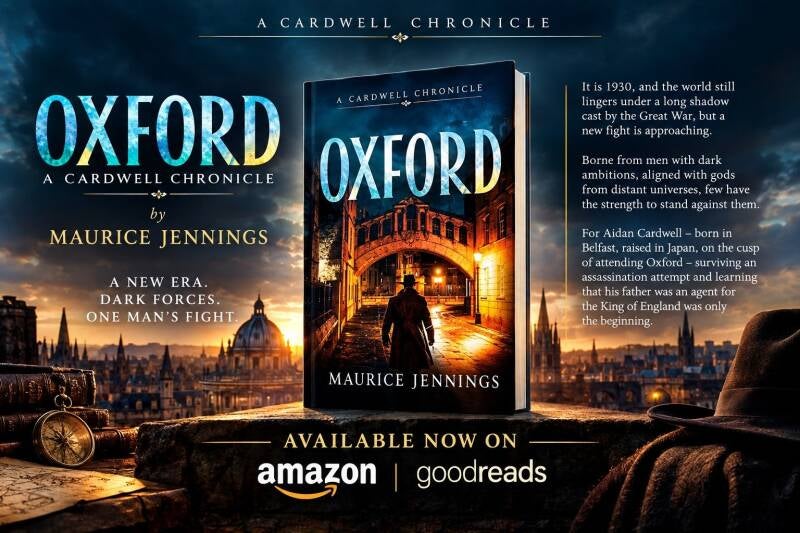
Well, I have just enrolled as a creative writing mentor for Writing Within Walls. Exciting to think I could be inspiring/encouraging a new generation of writers.
In this essay, I shall examine how the folklore, heritage, and history of the British Isles have influenced not just my fantasy writing, but that of other authors.
Fantasy literature, whilst mostly associated with fanciful worlds and supernatural elements, often draws upon real historical events and periods to help create a more believable story. Before fantasy officially became a genre at the turn of the 20th century, Edward Plunkett, otherwise known as Lord Dunsany, was writing incredible stories based around aspects of both British and Irish history. With a long and complex heritage filled with adventurers and pirates, entrepreneurs and explorers, political agitators and warriors, and a rich mythology that dates from prehistory, it all continues to inspire contemporary writers such as Michael Moorcock, Neil Gaiman and Ursula K. Le Guin.
My final project for my Master's degree included the early chapters of my new high-fantasy novel, Chosen, where a wayward knight, Aeron, haunted by a recurring dream that portents his death, is tasked with protecting a child who possesses the power to kill gods. Other character angles to the proposed novel are the God-king Lǣdan and Bada, a soldier in the army of the Dark Druid, to get a complete, rounded view of the storyline. Though I did not get to introduce the latter properly, the soldier was mentioned at the last battle of man and gods in Lǣdan’s vision of the future, mounted by Aeron’s side.
“Aeron turned to him, his green and grey irises uncompromising, his lips pressed tight. ‘Be strong, Bada. Today we save our world.’
The knight nodded. ‘Or we die trying.’”
As the story progresses, the reader was to discover that each of these characters was chosen to fulfil a particular role, hence the title of the proposed novel. I also wanted to experiment with my storytelling, so I decided on using a third-person limited point of view when exploring these main characters while the dream sequence I changed to first-person, though I only got to show that once and in the prologue, intending to make Aeron’s premonitory dream a more intimate scene with the reader. Whilst most writers do not go for this alternating perspective, some do, such as Simon Jimenez’s The Spear Cuts Through Water (2022).
“Beginning with The Lord of the Rings, fantasy literature often relies on the appropriation of certain elements [] though often in an idealized way.” (Schroeder Jr, 2016, p. 5) and it was not just Lord Dunsany that the history of the British Isles inspired.
Stephen Lawhead, in his Pendragon Cycle, written between 1987 and 2025, was largely based around King Arthur and the wizard Merlin, set during the early medieval period. Though not conclusively historical personalities, the era in which they are set certainly existed. David Gemmell, writing fantasy between 1984 until his death in 2006, again used Arthur in some of his novels, but he was not averse to using other histories for his world settings such as a conflict between fictional empires based on the Mongols and Romans or set a historical-fantasy story arc around actual people and events such as Alexander the Great and his father, Phillip of Macedon. Lastly, and perhaps most famously, there is J.R.R. Tolkien and his The Lord of the Rings (1968) saga, which was hugely influenced by his study and love of Anglo-Saxon and Norse history and traditions.
Even before all these modern writers and the fantasy trope came to the fore, the British Isles had already developed its own incredible literature. These include the 8th century heroic poem Beowulf (Alexander, 2003), filled with Germanic and Christian influences, Geoffrey of Monmouth’s pseudo-historical novel The History of the Kings of Britain (1973 [1136]) with its blend of history, legend and myth and later, the mighty Shakespeare, with such works such as Cymbeline, Macbeth, and The Tempest, all of which can be found in his complete works (Shakespeare and Bevington, 2013).
Whether in the past or modern, in The Road to Middle-earth (Shippey, 2005) claims that Anglosphere authors often draw upon Celtic, Anglo-Saxon, and Norse mythology, embedding those traditions and incorporating linguistic and cultural elements to contribute to the depth and authenticity of their fictional worlds that also contributes to creating a sense of continuity between the past and the present. Demmon’s, The Journey into Aslan’s Country: On the Creative Process of C.S. Lewis (2023) revels that Lewis’s “studies in medieval literature and mythology were other rich streams that flowed into his fiction” and that, like Beowulf, “Lewis’s fiction is also heavily steeped in his Christian faith” integrating Christian theological elements into his novels while also expertly weaving classical myths, medieval literature and mythology throughout.
When creating the creative section of my final project, my first thought was of the world which my main characters would have to traverse, which included their appearances and clothing, geopolitics and societal rules, language and place names, materials and technology, and mythology and religion. If I could make the world real to me by using existing historical materials, then at least I had a chance of making the world feel tangible for my reader.
“[I]n the hands of authors who understand their potential, the secondary worlds of fantasy provide a lens that can bring to sharp focus truths that the chaos of modern life obscures. J.R.R. Tolkien crafted a mythology for the modern world from ancient [T]eutonic sources, a mythology that expressed many people’s fears about industrialisation and world war. Mervyn Peake created a dark and painfully accurate reflection of the oppressive British class system in Gormenghast. And China Miéville transfigured Dickensian London and showed the daily exploitation of the poor and vulnerable that still powers the modern city in Perdido Street Station and his Bas-Lag Novels.” (Walter, 2011)
Some may ask, why did I even allow history to be used in my writing? In short, it is to keep my storytelling anchored. Using history in fantasy for the construction of worldbuilding allows for a familiar context with which readers can connect with, even in a world widely different to their own, with its own customs, languages, laws, and religions. For with dragons and warriors, there are farmers and traders, with magic and intrigue, there are kings and politicians.
“Fantasy as a genre is almost inextricably bound up with history and ideas of history.” (Maund, 1997, p. 468)
The child in Chosen, Nabu, was based on Jesus. I found a book, The Missing Years of Jesus: The Extraordinary Evidence that Jesus Visited the British Isles (Price, 2010), which focused on Jesus during the years between 18 and 30. Even though an archaeologist, Price offered no actual physical evidence, just a lot of theorising, but it still made me wonder. A child, born from a line of kings, hunted for what he might represent, forced to flee to a distant land for safety. I was not the first to use such a technique about such an iconic person from history and faith. C. S. Lewis, by use of a “typological approach,” portrayed Jesus in the personification of Aslan (Daigle, p. 42).
To write such a story might offend some, but fantasy allows us to view and discuss ideas at a distance, such as the horrors and traumas found within the real world while, at the same time explore themes such as sacrifice, love and loyalty; all issues which have resonated in human lives throughout history.
“People are inclined to write off fantasy as escapism, but in fact it’s a roundabout way of engaging with genuine problems. [] Most importantly, fantasy isn’t just for children. Becoming a teenager, rites of passage, facing failure and defeat, coming to terms with betrayal and disappointment - all the stuff of emerging adult life also has to be faced and coped with. Psychoanalysis and counselling have their place, but the most important tool we as humans have to tackle reality, is the creation of metaphor - the allegorical story. [] Taking one step away from reality to that “safe” place of pretend, prepares us to look the world’s harsh realities in the face. From there we can name the horrors and celebrate the joys before going back, with a clearer perspective on situations that bother us.” (Webb, 2007)
Keeping with the time of Jesus, historically, Judaea was already under Roman control, while Britain would have another 40 years before being successfully invaded by the empire. During that time, they gathered intelligence through trade and shared ideas, likely hoping when they finally occupied Britannia, the Roman way of life would not be so unfamiliar, though it really meant the introduction of innovative technologies, administrative systems, and cultural practices, which would have completely altered their existing social structure.
“Rome’s encroaching power would have been apparent within the British Isles well before its effects were directly felt, for the British had long had both trade and familial links with the Continent. Trading ports such as Hengistbury Head and Poole Harbour in Dorset regularly received news of what was happening on the Continent; and recent immigration from the area of present-day northern France and Belgium had forged such strong links that some British and continental tribal groupings shared ruling houses and even individual kings.” (Going and Boast, 1994, p. 104)
In fantasy literature, similar scenarios often involve a powerful external force that disrupts established norms. In Chosen, I hinted at this when describing Aeron. “[H]is dark hair was kept short, and his face clean-shaven like those of the Rumen Empire.”
In view of this, I continued using the Roman Empire as a basis for the belligerents in my story while using the Celtic nations as the protagonists, deciding that it was important for the storyline to have an ever-powerful realm pitted against an established people.
Though the Rumen military was only touched on, the colour of their tunics matched the dye used by the Roman emperors, and the segmented armour was like that of the Roman Legionnaires. I looked too at their outlook on life and sought to use Lǣdan to explore that theme — “There was an honesty to the Brythonic people, unlike that of the growing Rumen Empire, where guile and deceit seemed to be a way of life.”
The Brythonic Nation within Chosen, forced me to examine the Celtic world such as their clothing, homes and any social customs that I could use — the daub and wattle homes, the mention of a léine, a linen shirt Gabi when confronting Aeron, and the use of a currach, a 1st century small sailing boat used throughout Britain and Ireland, when Aeron wanted to explain how he felt within Dēaþ’s realm.
I decided also not to allow the use of contractions, wanting to create a formality in their words, as it was not a modern tongue. Their language I based on Old English, used as a common tongue throughout the world for simplicity, using specific words for the representation of gods and goddesses. In doing so, I named one of my characters ‘Wyrd,’ based upon the OE word for ‘fate’ (Eagles, 2023, p. 211), for that was what I had made her the personification of: Wyrd, the goddess of Fate. Following on from that, death became Dēaþ, God turned into Dryhten, and nature became Ġesċæft.
I patted myself on my back at my ingenuity, for who else would think of using such an old and now obscure language from early medieval British history? Little did I know, over a thousand years before, that for the Anglo-Saxons, Wyrd already was a goddess, brought to Britain as Urðr after several Germanic incursions, obviously having the same idea that I had!
Whether it is historical-fantasy, a subgenre of the fantasy classification, or high-fantasy, history provides thousands of years of trials and tribulations from growth, to death, to the rebirth of civilisations, either through mass immigration, natural disasters, political intrigue, revolution or war.
Within Chosen, we see the Rumen Empire has already encroached and conquered land inside the Great Brythonic Nation through Gabi — “‘Why are you still here, Gabi?’ Fabian asked. ‘I thought after you received your tattoos you might have returned to Timberland to help free your people from the Rumen Empire.’” and with some musings undertaken by Aeron, “Aeron nodded curtly, then looked to the cloudless sky, drinking in the warm air, allowing it to fill his lungs. It was hard to believe that on such a beautiful day there was any threat from the distant Rumen Empire. Yet such a truth constantly loomed over all their heads. Hillfort warbands regularly patrolled their borders and coast and guarded strategic points against possible naval landing sites, not just in fear of Rumen legionnaires but also from distant warring tribes.”
Though I did not have the space to show how different Rumen society was to the Brython, the aim was to show how the Brythonic Nation co-existed with the land and allowed women to be viewed as equal. In British history, Boudica and Queen Elizabeth I were two great British examples of this.
When Lǣdan looked upon the patrons within the Travellers Inn, “[i]t amused him to see some women laugh at that also, but then, in Brython, females held equal rights to their menfolk. It was not unheard of for women to lead men into battle, nor to hold positions of great responsibility and worth.”
The idea of a diminishing realm while another empire rises, leading to competing cultures, adds dynamism and realism to my piece for it has happened throughout British history, and created a setting that accurately reflects the complexity of human societies and the geopolitics that arise from it. Again in Chosen, I alluded to this by, “Fabian nodded. ‘True, but people are jealous of us. I overhead my father speaking with his captain. He fears that some tribes to the east are secretly aligning themselves with the Rumen Empire in fear of invasion, which everyone believes will ultimately come at some stage. He has called for a Hillfort Council, after which he will call for a White Hills Council and watch which chieftains make an appearance.’”
Many fantasy writers mirror real-world conflicts in scale and consequence and adapt elements such as betrayals, political alliances, and shifting power dynamics from historical wars. Famously, in recent times, George R.R. Martin, in his A Game of Thrones novel (1996), admitted to largely using medieval history as a basis for his book.
“I had read a lot of history, a lot of historical fiction, a lot of fantasy. There’s a certain dialogue that goes on between generations of writers, particularly science fiction and fantasy writers, because we’re part of this subculture. [] Like Tolkien, who hated the accusation he was doing allegory, and always bristled at the suggestion that [The] Lord of the Rings was about [] World War I, which he had fought in. I’m not writing allegory either, but I live in these times, and it’s inevitable that they’re going to have some influence on me. But during the process of writing these, I probably would have been much more immersed in the politics of the Middle Ages and the Crusades and the War of the Roses and the Hundred Years’ War.” (D’Addario, 2017)
But it does not always have to be about war. Even with Tolkien, Shippey observes that the decline of the Elves and the rise of Men mirrored certain historical processes, such as the transition from pagan to Christian societies (2005 [1982], p. 161).
For governance and law, I followed the idea of a feudal system that has been found in British society for the last 2,000 years, though it no longer exists in the terms we understand historically, but it is a hierarchical pattern I decided people would recognise. When Fabian, a member of the Hillfort People, was speaking of his father (a local chieftain) — “He has called for a Hillfort Council [tribal], after which he will call for a White Hills Council [provincial] and watch which chieftains make an appearance.” Whether discussing groups such as aristocracies or magical ones, it is a system readers can recognise and in an instant understand the dynamics.
Next came the mythopoeic creation of mythology within Chosen. Myths function as sacred histories that shape cultural identity as they are “the most general and effective means of awakening and maintaining consciousness of another world, a beyond, whether it be a divine world or a world of the Ancestors.” (Eliade, Myth and Reality, 1963, p. 139) This idea should be no different in a fictional world.
Within a Dictionary of Celtic Mythology (MacKillop, 1998), there are 4,000 alphabetised stories of enchanted landscapes, faeries, and shape-shifters that blur the boundaries between reality and imagination. Such narratives, in the Brythonic traditions, often emphasise the importance of the natural world and its connection to human experience.
I demonstrated this by — “Naoise nodded and looked into the shallow river at his feet. Bending forward, he dipped his fingers. ‘Through Ġesċæft, the goddess of Nature and Natural Order, the oak-seers use the water of the land to divine visions of the future, the past and the present. We connect with the water on a spiritual level and, through that, the whole of Middle-earth, the heavens above and the underworlds below. It is a strange connection, perhaps not unlike what you experienced. I am everywhere and nowhere, though I still keep my individuality. But that is why it is so hard to focus on just one event.’”
In my mythopoeia, like language, I again strove for minimalism and decided on one pantheon of gods for the whole of the world, though particular nations would worship one god specifically over another, such as those within the Land of Promise revered Dryhten — “Hers [Abiah] was Dryhten, the All-father, a god her people honoured above all others, as denoted by the Seal of Saar next to her left eye, two small overlapping and offset tattooed squares, which gave the impression of an eight-pointed star, within a circle.”
In The Invention of Tradition (Hobsbawm and Ranger, 1983, p. 9), cultural practices, such as those found in religion, are reimagined in fiction. “They seem to belong to three overlapping types: a) those establishing or symbolizing social cohesion or the membership of groups, real or artificial communities, b) those establishing or legitimizing institutions, status or relations of authority, and c) those whose main purpose was socialization, the inculcation of beliefs, value systems and conventions of behaviour.”
In the main I examined classical mythology for ideas of hierarchy for a pantheon, Celtic folklore for the basis of the Druidry and Norse lore for Middle-earth, a world lodged between two further otherworldly realms creating a backstory for the gods and the individual characters and where they lived within the cosmos. Following on from mythology, I added a general, worldwide priesthood that stretched across the world though they worship their own specific gods, such as Rachael, a Veiled One, with a secondary term of path-seer and a priestess of Wyrd, tying in with the goddess of Fate. The term ‘veiled one’ comes from the Irish word Cailleach but is found throughout the Celtic nations of the British Isles. It will be through these Veiled Ones within that I get to explore the morality of faith, power, and ideology.
The physical landscape of the British Isles also plays a role in shaping my fantasy story, contributing to the narrative with settings such as ringforts, hillforts, and large forests. Speaking of Aeron — “He was never one for enjoying too much sun, having grown up in the capricious Mountain Folk Province of Brython. Further north and west, his old home region was lodged between the greensward provinces of White Hills and Ériu, and provided its own unique, rugged beauty of deep valleys and mountain ranges.”
This leads on to terms for place names. Again I examined Celtic and Norse languages and their view on the world, using the rules they laid down, such as locations becoming linked with physical features. ‘Tor’ and ‘pen’ meaning hill or hilltop would be found in place names such as Torpenhow and Penrith, or ‘crag’ as in a promontory can be found in Friar’s Crag (Bragg, 2004, p. 5). ‘Ing’ in locations such as Ealing, Dorking and Worthing refers to ‘the people of,’ the ‘ton’ within Wigton, Wilton and Taunton, means enclosure or village, and the ‘ham’ in Birmingham, Chippenham or Grantham showed a farm (Bragg, 2004, pp. 6-7).
Following that same pattern, I created fictional places in the same manner. Eorþe is the Old English word for earth (soil) (Eagles, 2023 [2020], p. 240), Lone Ridge Fort is named after a ridge that overlooks that fortified town, and the Land of the Left Bank People was named after the population who lived on the one side of a major river within the Almain Nation.
Though the world speaks in the same language, my idea was to show cultural difference through physical appearances like tattoos for the Great Brythonic Nation, dark skin and eyes for the Land of Promise and those under Rumen control were to be short-haired and clean-shaven. The gods too were to be identified by their appearance and colours associated with their nature, such as with Descorde’s red hair — “[p]eople tend to associate red with negative, danger-bearing emotions. This could be because it is the color of fire, blood, etc…” (Cherry, 2025).
In Chosen — “Attired in a maroon dress, topped by a gold cuirass, she owned red-curly hair that matched her cold ruby eyes. Lǣdan’s heart sank.
Descorde!”
As the story continues, we would discover that the God-king’s hair colour, in his true form, was purple, a colour associated with kingship since the days of Alexander the Great “when purple dye was rare and highly expensive. [] Purple’s connection to royalty [has] continued into modern times. Notably, Queen Elizabeth II wore the Purple Robe of Estate after her 1953 coronation.” (Cherry, 2026)
I also decided on keeping the materials and technology true to the 1st century — iron, manual labour, travel by horse — whereas magic, and the strength behind it, displayed a greater supremacy of power, while the gods are more powerful still, creating a type of ‘layering,’ if you will. One way I presented this was when I had Lǣdan travelling through time, but allowing only the gods to view him.
“They looked at Lǣdan, acknowledging his presence, but said nothing. Next to Aeron, the storyteller watched himself approach. Shifting in his saddle, the God-king-in-the-future looked directly at him. His red eyes appeared bleak. ‘If you are seeing this, know this is the wrong path, and we have failed. We are all that is left in this cosmos.’
‘Who do you speak to?’ Aeron asked.”
But the gods are not designed to be omnipotent. This idea was shown by Lǣdan in the Traveller’s Inn. He could not understand why he had appeared in Lone Ridge Fort or see into the future of the patrons automatically, but had to use his power to view them, displaying limits even to the gods.
Another way I showed the difference between the gods and man was in the way they used their magic. “I noted there was no spell uttered from Nabu, no prayer, no word of power. On a world where man had to speak his magic, his power complied with a single desire; such was his supremacy. Much like the gods.”
By adhering to these rules, everything is aimed at maintaining a certain amount of believability in my created world. The interesting aspect of looking at British history and its interaction with Rome through a fantasy facet is how I display issues that may be sensitive to the modern world, especially since we are discussing a time when ‘might was right’ whereas today, feelings almost matter more.
Another exploration of an ethical dilemma is the concept of divine right, which underpins many leaders and royals throughout history. A writer who used philosophical debates within his fantasy novels was Gemmell, developing characters with dark pasts who stand up to do the right thing. Yet, without their past, would they be capable?
Going forward, I plan to explore further ethical considerations within Chosen. One future question would be Lǣdan’s central thought, after witnessing the last days of the universe, that perhaps he should kill the boy Nabu, for without the child, the Dark Druid and Descorde cannot see their scheme through. For him, the murder of Nabu is worth the safety of the universe. Of course, the boy from the Land of Promise could also stop the rising evil. Was that the track he took the first time and warned himself about? This also directly violates the principal law of the universe, where The Balance must be maintained, for where there are beings of magic, there too must be beings of anti-magic.
“Aeron sat more upright now. ‘So, tell me exactly what The Balance is?’
‘A good question. The cosmos works in a balance that constantly shifts but always seems to complement itself. With death, there is life; with youth, there is old age; with good, there is evil. These are just a few examples, and to rhyme them all off would take a full day. Even in the Otherworld, you have places of light and darkness. But to go to either extreme results in cataclysm and chaos and devastation for man. History has proven that.’”
As we can see, the use of British history within fantasy works on multiple levels, providing a framework for worldbuilding that lends depth to a fictional world and a chance to explore themes such as duty, identity, and the use of power. Through authors such as Dunsany, Lewis, and Tolkien, we can see just how much historical material from the British Isles can transform into a rich imaginative narrative.
Contemporary fantasy literature continues to draw on British history, often in more critical and self-aware ways and far from being escapist, that is continually developing into a sophisticated blending method of fact and fiction, which invite its readers to reconsider the boundaries between the two and showing that both are essential to our understanding of the world.
In Game of Thrones, the romanticised view of medieval society is replaced by a more brutal and realistic depiction, while others chase issues such as power, corruption, and inequality, whilst reflecting modern concerns with a growing emphasis on inclusivity and diversity. Where history purists might argue about the portrayal of the truth, fantasy has the freedom and distance to create a world of its own, unbound by politics. But even here, issues can still arise.
“[F]or ‘diversity’ to make sense and to fulfil its goals, it must challenge, reorient, and adapt the whole narrative and the structures within which its tropes operate. Stories that are not mindful of the types of spaces that BIPOC, queer, dis/abled, and otherwise marginalised characters occupy run the risk of perpetuating problematic and damaging representations that can have real-life implications and repercussions on people from these groups.” (Belaid, 2022, p. 256)
Nor should we ignore the incredible rise in recent years of romantasy which “centre [on] the “female-gaze” in which female desire, power and identity are explored from a female point of view. [] [W]omen have expressed that romantasy enables them to experience romantic and sexual fantasies that they might not experience in the real world, and helps them discover and experiment with their sexuality. Younger readers we spoke to found liberation in reading about realistic and non-taboo representations of women’s romantic and sexual fantasies. Women from conservative cultures said they were inspired by female characters who are not afraid or ashamed to seek out sexual pleasure. Romantasy, however, has a distinct draw. [] These stories feature experiences of consensual sex and female-centred sexual pleasure while also tapping into complex themes.”
Is this the rise of an official new subgenre within fantasy? “Onyx Storm, Rebecca Yarros’s third book in The Empyrean series, was the fastest-selling adult novel in 20 years when published in early 2025, according to The New York Times. It sold more than 2.7m copies in its first week. Bloomberg reported that romantasy was estimated to bring in US$ 610m (£455m) in sales in 2024, revitalising the publishing industry.” (University of Liverpool, 2026)
As we can see, the use of history from within the British Isles for fantasy literature is both extensive and multifaceted. From medieval political structures and mythological traditions to themes of invasion, identity, and landscape, British history provides a rich foundation for the genre. By adapting historical material creatively, writers construct worlds that are both imaginative and grounded in reality.
“[Fantasy] exists because it is (paradoxically) a kind of necessary realism, arising in response to qualities of the contemporary world that we couldn’t properly attend to, couldn’t narrate, any other way. I’d argue that, as well as expressing our frustrations with the disenchanted world, it’s also our best means for capturing the ways in which the world remains enchanted, for all our strenuous buffering. I read and write fantasy because it’s the literature that sees the recurrent unearthliness in human experience. That knows we’re hopelessly metaphorical creatures, who find meaning by tying together patterns of resemblance that might as well be spells. That knows there are some struggles where the stakes really are overwhelming, and good and evil in something like their pure forms really do pivot on human choices. Fantasy understands that to undertake the risks of love is to venture beyond safety, into landscapes strange to you, on perilous and wonderful journeys.” (Spufford, 2026)
As we now know, the relationship between fantasy and history is both intricate and indispensable. Far from being a genre detached from reality, fantasy is deeply intertwined with historical knowledge and experience, providing cultures, events, structures and themes, not just in Chosen, but also in a multitude of other fantasy novels that is not only imaginative but also grounded. Ultimately, the influence of history on fantasy writing underscores the enduring power of not just my storytelling but of others, proving that even in the most fantastical realms, the echoes of the past continue to shape our understanding of the present and our vision for the future.
5,017 words.
Bibliography
Alexander, M. (trans.) (2003) Beowulf: A Verse Translation. Penguin Classics, London.
Belaid, I. (2022) Building ‘Diverse’ Spaces in YA Fantasy: Publishers, Readers, and Media Adaptations [Online]. Available at https://discovery.ucl.ac.uk/id/eprint/10157580/2/Ikram%20Belaid%20Thesis%202022.pdf (Accessed 11th May 2026).
Bragg, M. (2004) The Adventure of English. Hodder & Stoughton, London.
Cherry, K. (2025) Red Color Psychology [Online]. Available at https://www.verywellmind.com/the-color-psychology-of-red-2795821#:~:text=Danger%20and%20Warning,color%20red%20can%20stimulate%20psychologically. (Accessed 12th April 2025).
Cherry, k. (2026) What Does the Color Purple Mean? [Online]. Available at https://www.verywellmind.com/the-color-psychology-of-purple-2795820#citation-13. (Accessed 12th April 2026).
D’ Addario, D. (2017) George R. R. Martin on the One Game of Thrones Change He ‘Argued Against’ [Online]. Available at https://time.com/4791258/game-of-thrones-george-r-r-martin-interview/ (Accessed 3rd April 2026).
Daigle, M. A. (1985). ‘Dante’s ‘Divine Comedy’ and C. S. Lewis’s ‘Narnia Chronicles” in Christianity and Literature, Vol. 34, no. 4, pp. 41–58. The John Hopkins University, Baltimore.
Demmon, E. (2023) The Journey into Aslan’s Country: On the Creative Process of C.S. Lewis [Online]. Available at https://anglicancompass.com/the-journey-into-aslans-country-on-the-creative-process-of-c-s-lewis/#:~:text=Mainly%20About%20Books,outpouring%20of%20his%20own%20character. (Accessed 14th April 2026).
Eagles, M. (2023 [2020]) Old English Dictionary, 2nd ed. The Choir Press, Croydon.
Eliade, M. (1963) Myth and Reality. Translated by W. R. Trask. Harper & Row, New York.
Hobsbawm, E. and Ranger, T. (eds.) (1983) The Invention of Tradition. Cambridge University Press, Cambridge.
Holdstock, R. (1984) Mythago Wood. Victor Gollancz Ltd, London.
Jimenez, S. (2022) The Spear Cuts Through Water. Del Rey Books, New York.
MacKillop, J. (1998) Dictionary of Celtic Mythology. Oxford University Press, Oxford.
Martin, G. R. R. (1996) A Game of Thrones. HarperCollins Publishers, London.
Mauld, K. L. (1997) ‘History in Fantasy’, in Clute, J. and Grant, J. (eds.), The Encyclopedia of Fantasy. Orbit, London.
Monmouth, G., (1973 [1136]) The History of the Kings of Britain (trans. L. Thorpe). Penguin Classics, London.
Price, D. (2010) The Missing Years of Jesus: The Extraordinary Evidence that Jesus Visited the British Isles. Hay House UK, London.
Schroder Jr, Jay A. A Medievalist Point of View on George R. R. Martin’s and Fire: Power and Women: An Examination of Daenerys. Cloud State University, Minnesota.
Shakespeare, W. and Bevington, D. (2013) The Complete Works of Shakespeare (7th edition). Pearson, London.
Shippey, T. (2005) The Road to Middle-earth: How J. R. R. Tolkien created a new mythology (3rd edition). HarperCollins, London.
Spufford, F. (2026) Myth, Monsters and Making Sense of a Disenchanted World: Why Everyone is Reading Fantasy [Online]. Available at www.theguardian.com/books/2026/feb/22/myth-monsters-and-making-sense-of-a-disenchanted-world-why-everyone-is-reading-fantasy (Accessed 29th March 2026).
University of Liverpool (2026) Romantasy: sexy tales of women-centred fantasy fiction are boosting the publishing industry [Online]. Available at https://news.liverpool.ac.uk/2026/01/23/romantasy-sexy-tales-of-women-centred-fantasy-fiction-are-boosting-the-publishing-industry (Accessed 11th May 2026).
Walter, D. (2011) George R. R. Martin’s Fantasy is Not Far From Reality [Online]. Available at https://www.theguardian.com/books/2011/jul/26/george-r-r-martin-fantasy-reality (Accessed 10th April 2026).
Webb, B. (2007) The Real Purpose of Fantasy [Online]. Available at https://www.theguardian.com/books/booksblog/2007/apr/23/bridgingthegapswhyweneed (Accessed 29th March 2026).
So several Oxford: A Cardwell Chronicle copies have been returned to my publisher. That apparently is not unusual, as shops only hold novels for so long, and if they are not sold, they have to make room for others. Disappointing to say the least, especially when everyone who has read it has loved the book, but it also means my royalties have been cut in half. Personally, I believe one issue is that it is marketed as YA, whereas it is really an adult novel. Lesson learnt, but there is nothing I can do until all the paperbacks are sold. Still, if I get Chosen: A Middle Earth Mythos completed and published, perhaps then others will look at Oxford.
So, I'm off work with burnout. All the years of writing, studying, and working have finally taken their toll. I’m always tired, feel a lack of motivation, and have brain fog, and yet physically I am complete. Everything just feels like an effort. It’s all rather strange.
The new novel I am writing, Chosen: A Middle Earth Mythos, continues. It is a separate story from Oxford: A Cardwell Chronicle, but with some overlap, namely in characters. I am now roughly 55,000 words in with an initial draft of 136,000 words, but I have already cut approximately 3,000 words from it. At this rate, the novel will probably be 110,000 words, the I can get back to the world of Oxford. Slowly but surely, I am getting there.
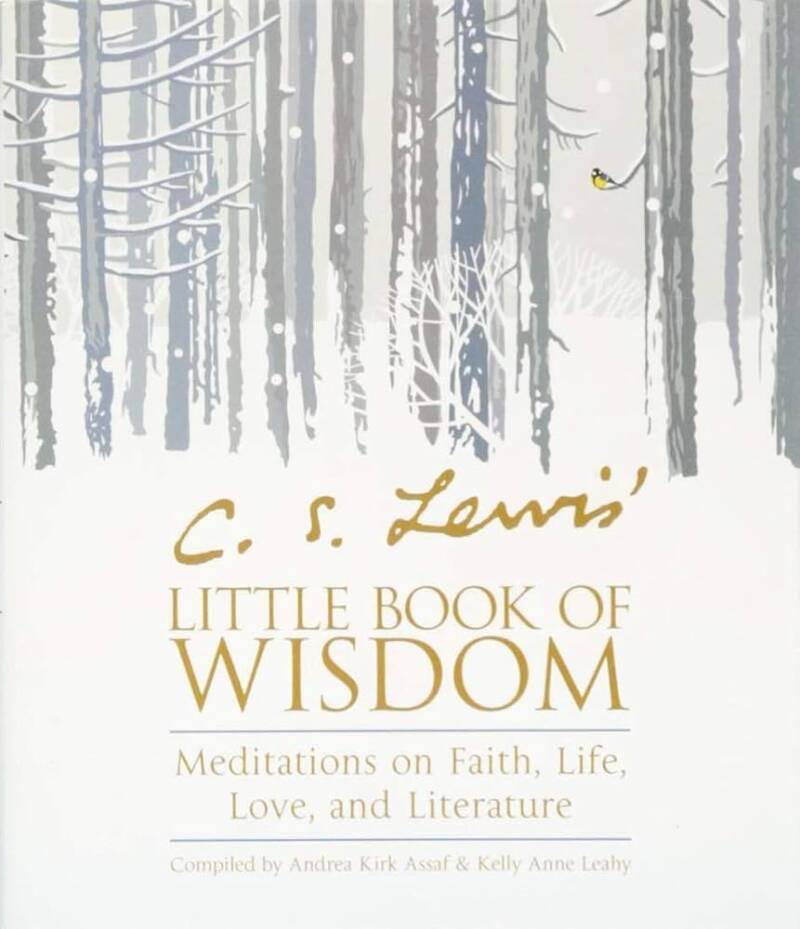
Book review: When I bought C. S. Lewis’s Little Book of Wisdom, it was to understand him better. I knew he was originally from Northern Ireland (my home), and I had used him as a character in my novel, Oxford: A Cardwell Chronicle, which in doing so, I had to learn what sort of man he was. I have also seen other writers speak of his beautiful writings. So I decided I would search for a book about his prose and methods. Unfortunately, this book did not have that. It was full of quotes from his other works, full of his own brand of philosophical stoicism alongside his view of Christianity, involving his pious nature towards his renewed faith, which I have to admit hit me as I knew at one stage he was a devout atheist. From one extreme to another. In a sense, I am jealous of someone possessing such a single-minded view of his Christian faith. Unfortunately for me, I am too cynical a person for that. An interesting book, I think I will look into others he has written. The following are some quotes that struck me the most.
“The task of the educator is not to cut down jungles but to irrigate deserts.” (p. 180), originally from The Abolition of Man.
“The safest road to Hell is the gradual one - the gentle slope, soft underfoot, without sudden turnings, without milestones, without signposts.” (p. 262), originally from The Screwtape Letters.
“Pride gets no pleasure out of having something, only out of having more of it than the next man.” (p. 269), originally from Mere Christianity.
“Everyone says forgiveness is a lovely idea, until they have something to forgive.” (p. 273), Mere Christianity.
This essay will explore how religion, brought to Britain after four major invasions from the 5th to the 11th centuries, influenced the English language.
When writing Oxford: A Cardwell Chronicle (Jennings, 2026), I had named one of my characters Wyrd, based upon the Old English word for ‘fate’ (Eagles, 2023, p. 211) for that was what I had made her the goddess of. Little did I know, a thousand years before, for the Anglo-Saxons, she was already one. In investigating wyrd, I discovered Urd, one of the Norns in Norse mythology, was its cognate, a word brought to the island during one of several Germanic incursions following the abandonment of Rome. Because Christianity remained steadfast within the country, wyrd, through time, evolved to become the direct forerunner to the modern English word ‘weird’ (Online Etymology Dictionary, 2025).
I wondered what other words had come to the shores of Britian, originating from an association to faith between the time of Constantine III (d.411 AD) taking his Roman troops from Britannia and the Norman invasion of 1066 under Duke William (c.1028-1087), which would become adopted and eventually become part of the English vocabulary. By using archival sources such as the Anglo-Saxon Chronicles and writers such as Bede, I will show how invading foreign religious words were adopted as the English language developed and grew. But to understand that, we also have to know early medieval British history and the four main incursions on the island.
The First Invasion: When the Romans left Britain in the early 5th century, so did a sense of abandonment and a Romano-British identity that had been built up over the previous four hundred years. Urban centres declined with little or no central authority to replace them. Local industry collapsed, as did international trade that came with being part of an empire. As coinage disappeared, local bartering rose. Writing and education vanished alongside this, and the security of the island that Rome so efficiently managed finally ended (Bowden, 2021).
Whether the chieftain kings of lower Britain invited the western Germanic tribes in for protection against the Picts or it was simply a matter of a land grab now that Rome had departed is uncertain, but Anglo-Saxon Chronicles speak of the warlords Hengist and Horsa, once employed by the British King Vortigern, who, by 449 AD, now fought against him, sending word to their homeland describing “the worthlessness of the Britons, and of the excellence of the land” (Swanton, 2000 [1996], p. 12).
The Germanic peoples heard them, and a consistent migratory flow of Angles, Jutes, and Saxons, along with smaller tribes, colonised eastern and lower Britain. And they were ruthless. In 491 AD, a clan of native Britons sheltering in the abandoned Roman fortress of Pevensey Castle was besieged. Here, Ælle and Cissa simply “killed all who lived in there” (Swanton, 2000 [1996], p. 15). There were no survivors.
Native Britons suffered more and more from the wrath of the invaders as they became the dominant force and were soon forced into one of two choices: slavery or integration. Refugees pushed westward into Cornwall, Ireland, Mann, Scotland and Wales, all regions that even today still continue to hold on to a Celtic identity, whereas England’s character has remained Anglo-Saxon.
Things were so dire for the people on the island that Saint Gildas (c.500-570 AD) mentioned in his book The Overthrow and Conquest of Britain of a letter sent to Flavius Aetius (c.390-454 AD) during this time of hardship. Entitled the “Groans of the Britons,” the message is reputedly to have said, “The barbarians push us back to the sea, the sea pushes us back to the barbarians; between these two kinds of death, we are either drowned or slaughtered.” (Winterbottom, 1978, p. 24) There was never any recorded answer to the British plight.
By the end of the 6th century, the invading Germanic tribes had occupied half of mainland Britain. With them came a polytheistic Germanic paganism, largely based on fertility, nature and warfare, along with all their associated mythological lore and their written language known as futhorc; a series of symbols, mostly straight lines, cut into hard surfaces such as bone, metal, stone and wood, allowing mainly for only practical and short communiques (Bragg, 2004, p. 10). South of Hadrian’s Wall, the land had also been divided up into several kingdoms — Essex, Kent, Sussex and Wessex denoting the settlements of eastern, southern and western Saxon tribes, Anglia named after the Angles, Mercia in the Midlands, and Bernicia and Deira to the north.
These Germanic tribes all spoke their own dialects, but would all eventually merge to become one religion and one language — a polytheistic Anglo-Saxon mythos and the development of what we now term Old English. So comprehensive was their destruction of the native Briton’s Brythonic language that less than 3% of Old English comprised any of their words and the few that remained were largely linked with nature, such as ‘crag’ meaning ‘rock,’ ‘pen’ meaning ‘hilltop,’ and several river names, including the Avon and the Thames (Bragg, 2004, p. 5). In comparison, in modern English, over 70% are words borrowed from other languages (Scheler, 1977, p. 74).
Another hint of this demographic replacement was the word ‘Welsh,’ derived from the Anglo-Saxon English word wealh meaning any speaker of a Celtic language, which included foreigners and slaves (Online Etymology Dictionary, 2025). Whereas modern Welsh is the descendant of a Brythonic language (Koch, 2006, p. 1757) today in Friesland they speak a dialect that is considered close to what Old English may have sounded like 1500 years ago (Winter, 2022).
Though it would have changed considerably since then, we can still recognise several of their words: dei meaning ‘day,’ froast meaning ‘frost,’ and grien meaning ‘green,’ to name just a few. In terms of faith, we find ‘church’ and the Frisian tsjerke, both have their origins in the Old English word cirice, which, when spoken aloud, phonetically sounds similar to the Frisian word. The basis for the Scottish and north English word ‘kirk’ also came from this, but is more similar to the modern Dutch word kerk (Hoad, 1993, p. 76).
The Second Invasion: From the east, at the very end of the 6th century, the re-emergence of Roman Christianity crept back into Britain and from Ireland came an expanding Celtic-Christian Church under Columbanus (c.543–615 AD) which had already found its way into Scotland and northern England. In 597 AD, Augustine of Canterbury (d.604 AD), under orders from Pope Gregory the Great (c.540-c.604 AD) arrived in Kent. Sometimes called the ‘Georgian Mission,’ his task was to meet with King Æthelberht (c.550-616 AD) on a mission of conversion.
It is possible that Æthelberht was targeted for two reasons. The first and obvious one was that his wife, Queen Bertha of Tours (c.565-c.603 AD), already a devout Christian, allowed for an opening into Anglo-Saxon Britain. The second was that the Kingdom of Kent was a powerful region from the earliest days of the Germanic invasions. If Æthelberht could be converted, others would likely follow Rome’s version of Christianity rather than a Celtic-Christian one.
Bede the Venerable (c.673-735 AD), the ‘Father of English History,’ wrote in his book, Ecclesiastical History of the English People, “At that time Æthelberht, King of Kent, was a very powerful monarch. The lands over which he exercise his suzerainty stretched as far as the great river Humber, which divided the northern from the southern Angles… Some knowledge about the Christian religion had already reached him because he had a Christian wife of the Frankish royal family whose name was Bertha. He had received her from her parents on condition that she should be allowed to practise her faith and religion unhindered, with a bishop named Liudhard whom they had provided for her to support her faith.” (Bede, 2008, p. 39)
In an article written by Jack Morato (2015, p. 15), suggested that Gregory’s alarm over an impending rift between the two churches might not have been the only reason for the ‘Gregorian Mission,’ alleging that the pope might have been genuinely concerned for the welfare of the Anglo-Saxons. This assumption is derived from a tale within Bede’s Historia where Gregory encountered some enslaved Deiran children.
Before Gregory became pope, “[when] some merchants had arrived in Rome, a quantity of merchandise was exposed for sale [where] he saw some boys put up for sale, with fair complexions, handsome faces, and lovely hair. On seeing them [Gregory asked] from what region or land they had been brought. He was told they came from the island of Britian, whose inhabitants were like that in appearance. He asked again whether those islanders were Christians. He was told they were heathen [and] that they were called Angli. ‘Good,’ he said, ‘they have the face of angels, and such men should be fellow-heirs of the angels in heaven.’” (Bede, 2008, p. 70)
Gregory, fully aware of Anglo-Saxon paganism, was resolved to bring Christianity to Britain and, with it, an end to slavery. Evidence suggested that Gregory never forgot those English children for in 595 AD, after he became pope, Gregory directed his agent Candidus to use some proceeds from the papal estates in Gaul to purchase English slaves so they could be sent to a monastery for their salvation.
“We desire that, when you proceed with the help of our Lord Jesus Christ to the management of the patrimony which is in Gaul, you would be so good as to buy with the money which you will receive clothes for the poor and English boys who are seventeen or eighteen years old, that they may be given to God and educated in the monasteries; to the end that the money of the Gauls, which cannot be spent in our land, may be usefully spent in the place where it belongs. [] we desire you buy clothes for the poor [] I desire that a priest be sent with them, lest any sort of sickness befall on the way [] be prompt in carrying out these things diligently.” (Crossley-Holland, 2009 [1982], p. 182)
By 601 AD, Æthelberht had converted to Christianity and allowed for a church to be established in Canterbury, making it a Christian centre of Britain even to this day. From there, ecclesiastics went out to spread the Word of God throughout his kingdom and beyond. Eventually, the whole of southern Britain became Christianised under Rome (Morato, 2015, p. 17) and so, Latin words of faith, which in turn hid Greek, seeped into Old English, and the “layering” (Bragg, 2004, p. 8) of what would become modern English began. With the rediscovery of Christianity, so too began its marvels.
According to Ben Johnson (Historic UK, 2015) during the mid-7th century, Cædmon (fl.c.657-684 AD) an uneducated cowherd stationed at Whitby Abbey in the Kingdom of Northumbria (a unified Bernicia and Deira), unable to sing and uneducated, would quietly depart the mead hall whenever the harp was passed around so not embarrass himself. One evening as he fell asleep among the animals in his care, he dreamt an angel had appeared before him, telling him to sing principium creaturarum — ‘the beginning of created things.’
Miraculously, Cædmon found he could sing, and, with the memory of the dream staying with him, allowed him to recall the holy verses for his mistress, St Hilda (c.614-680 AD) and members of her inner circle. When Cædmon could produce further religious poetry, it was decided that the gift was a blessing from God, and took vows to become a monk, learnt his scriptures and the history of Christianity, producing beautiful poetry as he did so.
Unfortunately, Cædmon’s Hymn was all that survived of his works, though he was credited with being the first Anglo-Saxon poet whose work had survived. Originally in Latin, likely for the ecclesiastical community, it has since been translated into both Old English and modern English. Below is the Latin version:
“Nunc laudare debemus auctorem regni caelestis, potentiam creatoris, et consilium illius facta Patris gloriae: quomodo ille, cum sit aeternus Deus, omnium miraculorum auctor exstitit; qui primo filiis hominum caelum pro culmine tecti dehinc terram custos humani generis omnipotens creavit.” (Plummer, 1961 [1896], pp. 259-260)
The following two versions are in Old English and its modern translation (Alexander, 1991, p. 12):
“Nu sculon herigean heofonrices Weard, Meotodes meahte ond his modgeþanc, weorc Wuldorfæder; swa he wundra gehwæs ece Drihten, or onstealde. He ærest sceop eorðan bearnum heofon to hrofe, halig Scyppend: þa middangeard moncynnes Weard, ece Drihten, æfter teode firum foldan, Frea ælmihtig.”
“Praise now to the keeper of the kingdom of heaven, the power of the Creator, the profound mind of the glorious Father, who fashioned the beginning of every wonder, the eternal Lord. For the children of men he made first heaven as a roof, the holy Creator. Then the Lord of mankind, the everlasting Shepherd, ordained in the midst as a dwelling place, Almighty Lord, the earth for men.”
And just like that, with the recruitment of the wealthy and the influential throughout Britain, Christian worship became integrated into the developing English language, never to be removed, for it brought back to those communities, largely illiterate since the abandonment of the Rome, a written and spoken language with books of exquisite décor, and a new way of living.
To the north, dated during the 8th century, the stone Ruthwell Cross, then in the Kingdom of Northumbria, not only displayed events in the life of Christ but was also inscribed with a sophisticated futhorc poem. The Dream of the Rood, in which Christ’s last days are told from the perspective of the cross on which he was crucified, is displayed for all to see, demonstrating a clarity between idea and language.
In Old English, the first sentence reads, “Hwæt iċ swefna cyst secgan wylle, hwæt mē ġemǣtte tō midre nihte syðþan reordberend reste wunedon.” In modern English, it says, “Listen! I will describe the best of dreams which I dreamed in the middle of the night when, far and wide, all men slept.” (Crossley-Holland, 2009 [1982], p. 200)
Writing preserved language, and with writing came uniformity, a way a uniting a populace, but it also rode roughshod over those tongues and traditions that were passed down orally. Like all subjugators before them, such as Rome and the invading Germanic tribes, the written word and Christianity could not allow the losing side to keep a foothold, so words either integrated or were dropped. Soon writing became legitimised and the language of Christian faith within Britain became the primary authority of the soul.
In the north, Aidan of Lindisfarne (c.590-651 AD), an Irish Celtic-Christian priest, along with fellow Hibernian monks, had brought religious manuscripts across the Irish Sea, but the 24 letter alphabet was forced to absorb aspects of the English language as Greek and Latin did not possess letters for Old English sounds (Crystal, 1987, p. 203) and so language through religion was built on, refined, expanded and shared, becoming the alphabet we know today.
An example of this fusion of cultures are the four Lindisfarne Gospels, thought to have been produced during the 8th century — the same time as the Ruthwell Cross. They were a mixture of Greco-Roman and Celtic-Christianity with the additional Anglo-Saxon language, today known as a Hiberno-Saxon style (Martinez, 2022). Coincidentally, it was also about this same time Bede was working on his tome, in a monastery at Jarrow, also in the Kingdom of Northumbria, once a hub for Celtic-Christianity doctrine.
Latin, once the language of academia and the ecclesiastical, was now being supplemented by the new growing native language once primarily used for more functional matters such as the charters, laws, and the daily grind of life in the early medieval British world (Bragg, 2004, p. 12). By the 11th century, even the Lord’s Prayer had been standardised in Old English, such as the one found within the Wessex Gospels, under the care of Ælfric of Eynsham (c.955-1010 AD), an ecclesiastical scholar reputedly to be on par with Bede.
“Ure Fæder, ðu ðe eart on heofonum, sí ðín nama gehálgod. Tócume ðín ríce. Geweorðe ðín willa on eorðan swá swá on heofonum. Sęle ús tó-dæg úrne dæghwamlican hláf. And forgif ús úre gyltas, swá swá wé forgifað úrum gylten-dum. And ne lǽd ðu ús on costnunge. Ac álýs ús fram yfele. Sí hit swá.”
Spoken aloud, the above words can sound rhythmically similar to the modern English language and the Lord’s Prayer, though the actual translation in the order of the words are: “Our Father, thou that art in heavens, be thy name hallowed. Come thy kingdom. Become thy will in earth as in heavens. Give us to-day our daily bread. And forgive us our guilts, as we forgive our offenders. And not lead thou us into temptation. But release us from evil. Be it so.” (Cook, 1891, p. 59)
Even though the conversion of Christianity had taken hold, archaeological evidence, such as the dig at Sutton Hoo which began in 1938, demonstrated that perhaps people still edged their bets, as the burial site there and further afield contained both Christian and pagan artefacts in preparation of an afterlife (Gilley and Shiels, 1994, p. 25). Yet 500 miles to the north, in the late 8th century, another invasion was about to begin, one which would challenge the English language for the next two hundred years.
The Third Invasion: “793 — In this year dire portents appeared over Northumbria and sorely frightened the people. [] A great famine immediately followed those signs, and a little after that in the same year, on 8th June, the ravages of heathen men miserably destroyed God’s church on Lindisfarne, with plunder and slaughter.” (Crossley-Holland, 2009 [1982], p. 39)
For almost three hundred years, the Vikings raided Scotland and the border regions that split that northern country from England. It was the Danes though who landed with force, occupying great swathes of Anglo-Saxon lands and replacing them, keeping their own language and religion, threatening to do unto the Anglo-Saxon communities as they had done to the Romano-Britons only a few hundred years earlier.
The Lindisfarne monastery was destroyed by the Vikings, the jewels within their gospels ripped apart and worn around the necks of the victors, yet the Lindisfarne Gospels themselves survived. A year later, the Vikings returned to pillage the monastery at Jarrow and burnt down its magnificent library. These were places of great riches but low defences, and by targeting such places of authority and learning, it stated God was no longer on the side of the Anglo-Saxons.
In 865 AD, the Great Heathen Army, which became the presiding invading force, landed in East Anglia intending to occupy the country. At Chippenham, 878 AD, Alfred, King of Wessex (c.848-899 AD), was defeated by the Danes by breaking their truce and outflanking him. He escaped and went into hiding, sending out a call to any West Saxon men who refused to capitulate and were open to a new form of combat.
Alfred fought a guerrilla war, killing the enemy before they had time to react, then disappearing into the marshes and forests, but still he understood such tactics would only get them so far. A pitched battle would still have to occur, for the Danes would not surrender their new and fertile land unless they were forced to do so. In 878 AD, they met at Edington, where Alfred led his army uphill against an entrenched enemy.
“There [Alfred] fought against the whole army and put it to flight, and pursued it as far as the fortress, and stayed there a fortnight. [] Three weeks later King Guthrum with 30 of the men who were the most important in the army came [to him] at Aller, which is near Athelney, and the king stood sponsor to him at his baptism there.” (Cross-Holland, 2009 [1982], p. 41)
After Guthrum (c.835–890 AD) was Christianised, he took the name of Alfred’s deceased other brother, Æthelstan, and returned to East Anglia, where he reigned as king under that name until his death. After the war, a diagonal border was drawn up from the Thames to the old Roman road of Watling Street. To the north and east was the rule of Danelaw, and to the south and west was West Saxon. Only those trading goods could cross the line, but it was this commerciality which would also add to the English language, for the people on the shared island had to speak to one another, and clarity became paramount, for even then, money talked.
When the battles ended and the peace treaties were finally enacted, Alfred next took stock of the education of his people, for he saw it in ruins after the destruction of so many ecclesiastical buildings. As a result, he re-instituted scholarship and learning, and the Britons, largely because they were Christianised, were writing their words down on parchment or vellum, which allowed their language to be spread easily among the people and the country.
English not only survived the war against the Danes, but it also benefited. Where Danelaw existed, so too did the Norse language and religion. Runes, like futhorc, were used primarily in carvings on materials like metal, stone and wood, and the invaders’ words were adopted.
At 40, he studied Latin so he could better understand the teaching of the Roman church and had five Latin-inscribed books associated with history, philosophy and religion translated into Old English so his people could better understand them. He essentially created the first printing house, an idea unmatched anywhere in Europe. The undertaking was expensive, yet he did it and had copies sent to the twelve bishops scattered across his kingdom. Alfred would later be called ‘The Great’ and the ‘Saviour of England,’ even before England strictly became a unified country, but arguably, he went a long way in saving the English language.
“I [Alfred] remembered also that I saw, before it had been all ravaged and burned, how the churches throughout the whole of England stood filled with treasures and books; and there was also a great multitude of God’s servants [] they could not understand anything of them, because they were not written in their own language. Therefore it seems better to me [] for us to translate some books which are most needful for all men to know into the language which we can all understand [] until there are able to read English writing well.” (Crossley-Holland, 2009 [1982], pp. 219-220)
In Alfred’s own translation of Pope Gregory the Great’s Pastoral Care, written around 590 AD and brought to England by Augustine, the King of Wessex, in the preface, described his language as “Englisc” when denoting his tongue, perhaps even his identity, when explaining why he was translating the book from Latin (Sweet, 2025 [1871]). By doing this, he used Christian religious language as a rallying point for unity among his people.
When Æthelstan (c.894-939 AD), grandson of Alfred, took York from the Danes in 927 AD, he became the first Anglo-Saxon king to rule over the whole of England. However, almost one hundred years after Alfred’s death, the Danes attacked once more. At the Battle of Maldon in 991 AD, the Danes defeated the English and demanded Danegeld (a protection tax) on the Anglo-Saxons, forcing King Æthelred (c.968-1016) to flee to Normandy in 1013.
Though the Danes were once again in charge, the English language and faith was now more deeply rooted, protected by Cnut (c.990-1035), the Danish King of England, himself a Christian and a supporter of Wulfstan, Archbishop of York (d.1023). It was during this time that Ælfric, mentioned above, while penning the Lord’s Prayer, his contemporary Wulfstan was writing homilies between 1010-1016, blaming the lack of English faith for falling foul of God and, as punishment, He invited the Danes into their land.
“Understand also completely that the devil has deceived this people too much, and that there has been little faith among men, though they speak fair words, and too many crimes have gone unchecked in the land. [] Because with great deservings we have earned the miseries which lie upon us, and with very great deservings we must obtain the remedy at the hands of God if henceforth things shall become better.” (Crossley-Holland, 2009 [1982], p. 294)
Eventually an Anglo-Saxon king, Harold Goodwinson (d.1066 AD), his name hinting at his Danish heritage, would sit once again on the throne of England, but he would be the last to do so, falling to an enemy who sought to destroy the English language once and for all.
The Fourth Invasion: When Duke William landed on the British coast from Normandy, he went straight to Pevensey Castle — the very castle where the locals were massacred during the Germanic tribal invasion by Ælle and Cissa, almost 600 hundred year earlier — “on Michaelmas Eve. [] King Harold was informed of this [] and came against him at the hoary apple-tree. And William came against him by surprise. [] the king nevertheless fought hard against him. [] There King Harold was killed.” (Crossley-Holland, 2009 [1982], pp. 42-3)
With the death of Harold so too was it the near-death of the English language for with the rise of the Normans, came the rise of a new primary language, Old French, that, within in few hundred years, had killed off approximately 85% of Old English (Baugh and Cable, 2005 [1951], p. 49). ‘Hastings,’ made famous by the battle, is from an Old English word whereas ‘Battle,’ the actual site of the conflict, was a newly introduced Norman word.
“He [William] went inland with all his army [] and ravaged all the region that he overran until he reached Berkhamstead. [] Bishop Odo and Earl Williams stayed behind and built castles far and wide throughout this country, and distressed the wretched folk, and always after it grew much worse.” (Crossley-Holland, 2009 [1982], p. 43)
The coronation service that crowned William King of England on Christmas Day in 1066 was in both Old English and Latin, though William spoke only French the whole time, and under the new foreign feudal system that was introduced, British society was changed forever. Native language and identity were suppressed. French came to rule the church, the ruling class, entertainment, education, the law and the military — anything associated with governance. Castles and cathedrals were built purposely high above the local single-storied wooden buildings, displaying Norman power and status, proudly announcing that God was on their side.
In 1070, Lanfranc (c.1008-1089), a loyal supporter of William, was appointed Archbishop of Canterbury. He insisted that all English churches, including the church at York, its own Episcopal see since the days of the Celtic-Christianity, must surrender to his authority. Lanfranc also demanded a strict adherence to the Roman Catholicism, with loyalty to the pope above all else, an end to simony and nepotism, the enforcement of celibacy to strengthen moral authority and the provision of administration to the Crown and the development of great landownership. Lanfranc himself was given sole authority to deal with legal matters for the church and spoke on William’s behalf when the king was out of the country (Cowdrey, 2003, pp. 175-84).
In 1086, William commissioned the Domesday Book, of which there were two volumes. Written in Latin, its pages reveal that half the country lay in the hands of just 190 French nobles, and half of that was held by just eleven men. Not one of them spoke English (Bragg, 2004, p. 39). By this time, only Wulfstan, Bishop of Worcester (c.1008-1095) and nephew to the above-mentioned Archbishop Wulstan, was the last British-born member of the clergy to hold any position of power (Barlow, 1979, p. 57). From this, in terms of hierarchical language, Norman-French came first, followed by Latin for all its sacred and secular purposes, and last, in their own land, came English. And this pattern would continue.
Some 60 years after the Norman Conquest, a monk by the name of William of Malmesbury (c.1095-c.1143) would write, “England has become the habitation of outsiders and the dominion of foreigners. Today, no Englishman is earl, bishop, or abbott, and newcomers gnaw away at the riches and very innards of England; nor is there any hope for an end of this misery.” (Thomas, 2003, p. 56)
In 1154, Hugh Candidus, a monk at Peterborough Abbey (c.1095-c.1160) wrote, “He [William de Waterville] has made a good beginning. Christ grant that he may end well.” (Mellows, 1949, p. 139)
That, the last entry ever written entry in an Anglo-Saxon chronicle, was a continued marker of the Norman attitude toward the British, their language and their faith. But it would not stay dead.
English remained the language of the people, though it changed significantly with the additional French linguistic structure, to become virtually unrecognisable to the people of Britain pre-conquest. It would not be until the reign of King Henry IV (1367-1413) before English, or as we now know it, Middle English, would once again become the official tongue of the country. And it has continued to develop ever since.
Place names such as Alkham, Harrow-on-the-Sea and Weyhill give evidence of the once pagan sites that stood there, containing altars, sanctuaries and temples. Even today, the figures of old Germanic religious figures are modernised and used, such as Wayland the Smith in Rudyard Kipling’s Puck of Pook’s Hill (1902) (Gilley and Shiels, 1994, p. 25).
As we can see, from the origins of Germanic migrations came a language of various dialects before becoming unified under Old English and an Anglo-Saxon mythology. It was altered further by incorporating Greek and Latin through Christianity, and pushed forward by Alfred the Great, added to by the Danish invasions, to be almost completely overwhelmed by the Normans and their strict Catholic adherence. Those Old English words which still existed were either dropped, forced to convert, or were substituted with a more recent, doctrine-influenced term.
Below are some words that originated from varying faiths of invaders and occupiers from the 5th to the 11th centuries that we still use today, largely taken from the Concise Oxford Dictionary of English Etymology (Hoad, 1993) and the Online Etymology Dictionary (2025).
Abbess, originally OE. abbodesse, it later developed into abbotess, only for the word to be replaced by ME. abbese during the 1300s, taken from the OF. abbesse, from the L. abbatissa.
Bishop, from the OE. bisċop, from the L. episcopus, which came from the Gr. epískopos.
Christ, from the OE. crist, from the L. Christus from the Gr. khristos. It drove out the OE. term for Jesus, Hæland.
Devil, from the OE. deofol, from the L. diabolus, from the earlier ecclGr. diabolos.
Easter, thought to be derived from an Anglo-Saxon fertility goddess Ēastre, who was worshipped during a springtime festival, it was kept only because of it coinciding with the rising religion of Christianity and the Jewish festival of Passover, which was held during spring.
Friday was based on Frīgg, a Norse goddess of clairvoyance and motherhood, which became the OE. term Frīġedæġ, meaning ‘day of Frig.’
God, from the OE. god.
Heaven taken from the OE. Heofon.
Incubus, from the L. incubus.
January comes from the Anglo-F. Ieneuer, from the L. Ianuarius, meaning ‘the month of Janus’ named after the Roman god.
Kirk, prevalent in northern England and Scotland from c.1200s, originated from the ON. Kirkja. From c.1500s Kirkland is also known as ‘church land.’
Lamb, as typified by the paschal lamb, from the OE. lamb or lomb, was also used to describe a gentle or innocent young church member from just before the Norman invasion.
Mass (church) originates from the L. messa or missa to the OE. mæsse to the ME. masse.
Nun, from the OE. nunne, from the L. nonna.
Oblation from OF. oblacion directly from the L. oblationem.
Pope, from the OE. papa, from ecclL. of the same word, from the Gr. papas.
Quadragesima, another word for Lent, from the ME. Quadragesime from the L. quadragesima.
Reconcile, as in ‘Christ restoring sinners to Grace,’ from the OF. reconcilier, which is directly from the L. reconciliare.
Saint, from the OF. saint or seinte, replacing the OE. sanct, all of which originate from the L. sanctus.
Thursday came from ME. Thuresdai which came from OE. Þurresdæg, a contraction of ON. or Þunresdæg or Thor’s Day. Holy Thursday in ME. was Ascension Day — 40 days after the crucifixion.
Ubiquity, originally theological in terms of God’s omnipresence, comes from the L. ubiquitas from the earlier L. ubique.
Verse, OE., replacing an earlier OE. fers, from L. versus.
Wafer from the Anglo-F. wafre that would include the Eucharist bread by the 1550s.
Xmas, a shortened form for Christmas since 1755, was preceded by X’temmas first used in 1551, which came from the OE. Χp̃es mæssa from Cristes mæsse.
Yule, from the ME. yol, youle, from OE. ġeōl meaning Christmas or Yule.
Zeal, in the sense of faith and study, from the ME. zele from the OF. zel, directly from the L. zelus from the ecclGr. zēlos.
BIBLOGRAPHY
Alexander, M. (ed.) (1991) The Earliest English Poems. Penguin Classics, London.
Barlow, F. (1979) The English Church 1066-1154: A History of the Anglo-Norman Church. Longman, New York.
Baugh, A. and Cable, T. (1951 [2005]) A History of the English Language. Taylor & Francis, Abingdon.
Bede (2008) The Ecclesiastical History of the English People (translated by J. McClure and R. Collins). Oxford University Press, Oxford.
Bowden, Will (2021) The fall of Roman Britain: how life changed for Britons after the empire [online]. Available at https://www.historyextra.com/period/roman/fall-roman-britain-empire-what-happened-why/ (Accessed 8th December 2025).
Bragg, M. (2004) The Adventure of English. Hodder & Stoughton, London.
Cook, A. (1891) ‘The Evolution of the Lord’s Prayer in English.’ The American Journal of Philology, vol. 12, no. 1, pp. 59-66.
Cowdrey, H. (2003) Lanfranc: Scholar, Monk, Archbishop. Oxford University Press, Oxford.
Crossley-Holland, K. (2009 [1982]) The Anglo-Saxon World: An Anthology. Oxford University Press, Oxford.
Crystal, D. (1987) The Cambridge Encyclopaedia of Language. Cambridge University Press, Cambridge.
Eagles, M. (2023 [2020]) Old English Dictionary, 2nd ed. The Choir Press, Croydon.
Gilley, S. and Sheils (eds.) (1994) A History of Religion in Britain. Blackwell Publishing, Oxford.
Martinez, V. (2022) Hiberno-Saxon Style (Insular Art) [online]. Available at https://www.ebsco.com/research-starters/arts-and-entertainment/hiberno-saxon-style-insular-art#background (Accessed 8th January 2026).
Etymonline (2025) Online Etymology Dictionary [Online]. Available at https://www.etymonline.com (Accessed 8th December 2025).
Gregory the Great (1890) Letter to Candidus, Presbyter: A Select Library of the Nicene and Post-Nicene Fathers of the Christian Church (eds.) Philip Schaff and Henry Wace (trans.) James Barmby. W.M.B. Eerdmans Publishing Company, Grand Rapids.
Hoad, T.F. (ed.) (1993) The Concise Oxford Dictionary of English Etymology. Oxford University Press, Oxford.
Jennings, M. (2026) Oxford: A Cardwell Chronicle. Troubador Publishing, Harborough.
Koch, J. (2006) Celtic Culture: A Historical Encyclopedia. ABC-CLIO, Santa Barbara.
Mellows, W. (1949) The Chronicle of Hugh Candidus. Oxford University Press, Oxford.
Morato, J. (2015) The Making of the Medieval Papacy: the Gregorian Mission to Kent. Saber and Scroll Journal, Vol. IV Issue III, December 2015, pp. 6-33.
Plummer, C. (ed.) (1961 [1896]) Venerabilis Bede Historiam Ecclesiasticam Gentis Anglorum. Oxford University Press, London.
Scheler, M. (1977) Der Englische Wortschatz: Grundlagen der Anglistik und Amerikanistik. Erich Schmidt, Berlin.
Swanton, M. (Trans. and ed.) (1996) The Anglo-Saxon Chronicles. Orion Publishing Group, London.
Sweet, H. (2025 [1871]) King Alfred’s West-Saxon Version of Gregory’s Pastoral Care. Routledge, Abingdon.
Thomas, H. (2003) The English and the Normans: Ethnic Hostility, Assimilation and Identity, 1066–c.1220. Oxford University Press, Oxford.
Winter, C. (2022) Frisian [online] Available at https://oxfordre.com/linguistics/display/10.1093/acrefore/9780199384655.001.0001/acrefore-9780199384655-e-938?d=%2F10.1093%2Facrefore%2F9780199384655.001.0001%2Facrefore-9780199384655-e-938&p=emailAy8xv1Kith4sk#acrefore-9780199384655-e-938-div1-1 (Accessed 11th December 2025).
Winterbottom, M. (1978) Gildas: The Ruin of Britain. Phillimore & Co. Ltd, Chichester.
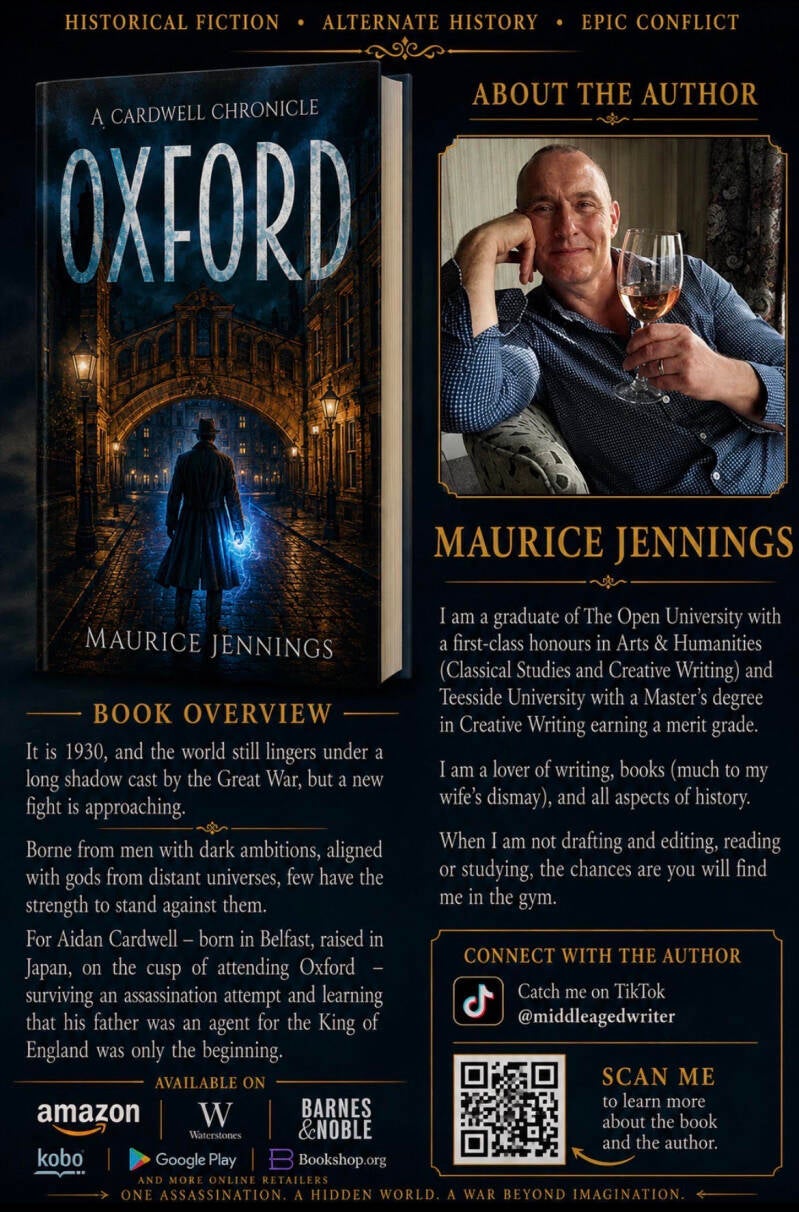
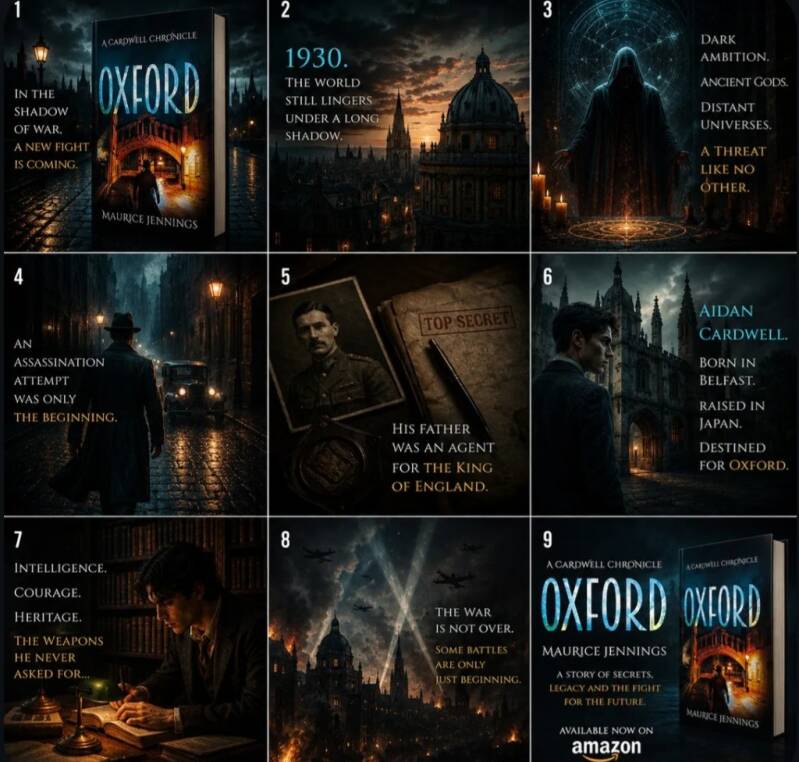
A couple of new pics for Oxford: A Cardwell Chronicle.
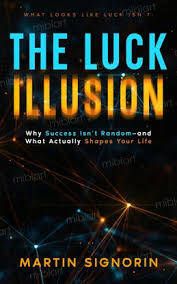
To be honest, when I started reading this book, I wondered what the point of it was. The prose shows clarity and the narration gentle, but the ‘Luck Illusion’ is not a large book, and by its title you can guess there is no such thing as luck, but a matter of circumstance. Yet, by the end, it made me solidify views which I had long suspected and immediately examine my locality and my place within it.
“Not: Why did life choose this person? But: what made this outcome possible, what made it powerful, and what remains open to influence?” (p. 95)
Within the ‘Luck Illusion,’ these lines struck me. I looked to my own small town. Once we had a college, but it closed. With that, the students left. With no students, bars, cafes, and nightclubs closed. Tax revenues for the local council lowered. A major retail shopping name came. Independent shops closed, unable to compete with a major business in the centre of town. Schools were amalgamated. Housing has shot up everywhere, but no further infrastructure was introduced. Now residents struggle over ever-diminishing resources and employment opportunities, especially those on the lower economic scale. I sit with a master’s degree but do only a menial job. Mass immigration drains our delicate resources even further. In short, my town is dying, and the people living here, by extension, will have their ‘luck’ in life dramatically reduced. I look to my friends who moved to another, more affluent country. After decades of living there, all of them are thriving in comparison.
By reading this book, I discovered that it is not only the large events that happen to a person which can dictate their life, but a series of negligible external factors alongside personal choices that accumulate over years and decades.
If I could, this is a book I would introduce to those beginning their working life or even parents of young children, who might view the world around them with wider eyes and come to realise that the choices they make now might offer greater opportunities later in life.
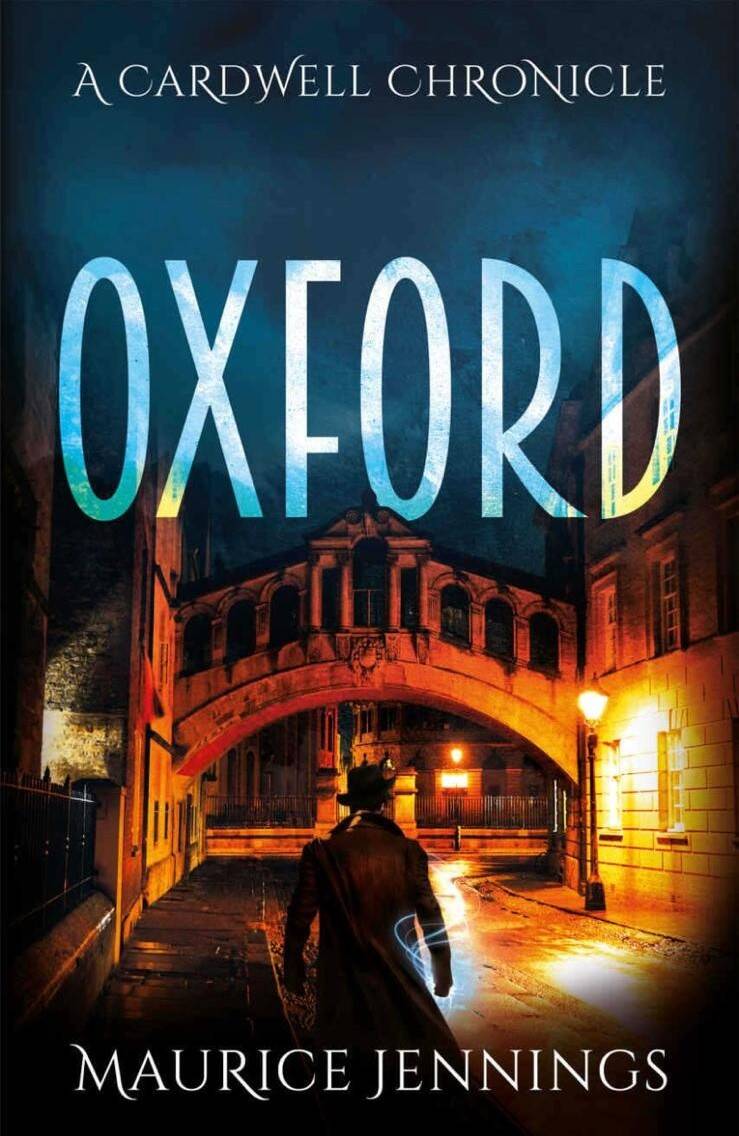
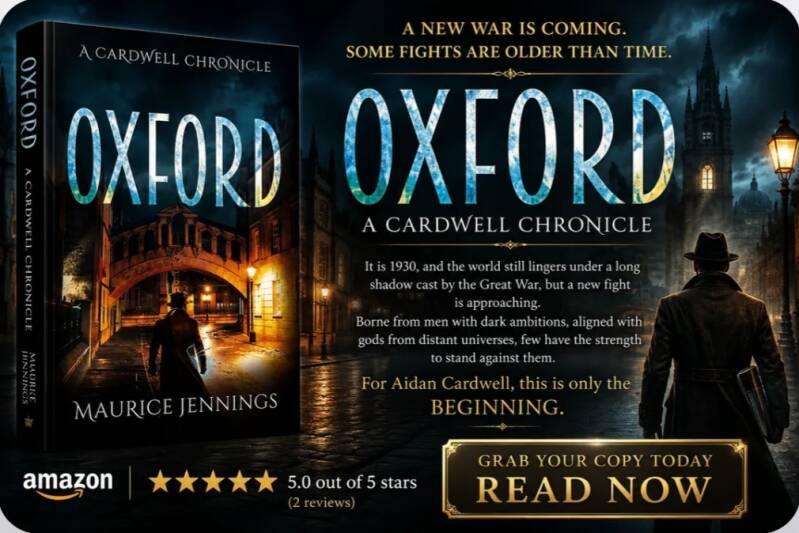
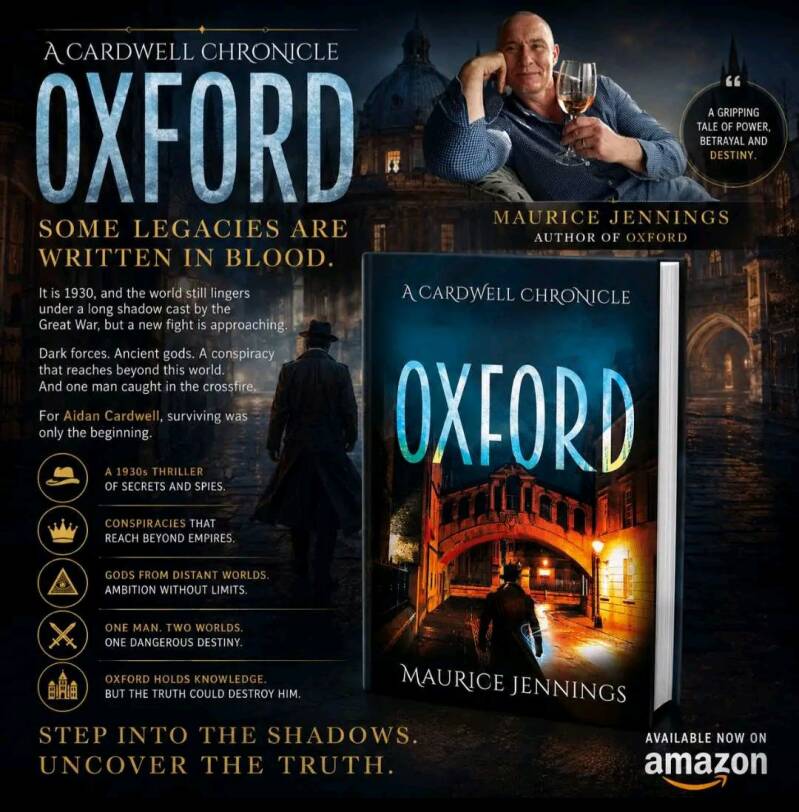
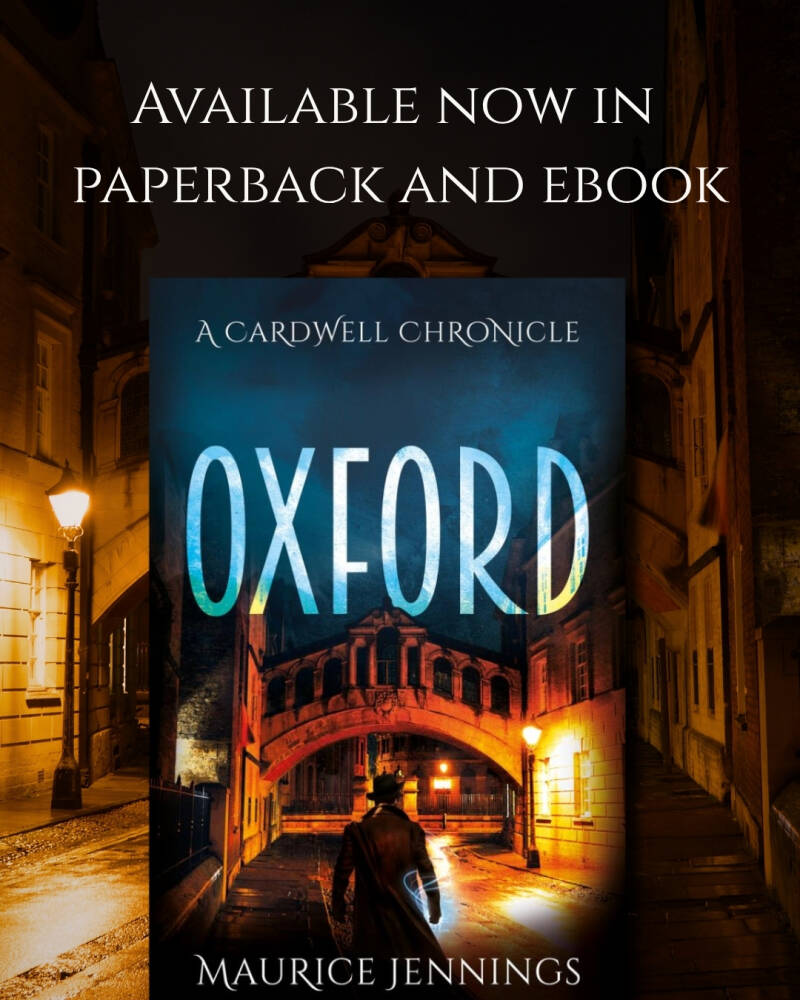
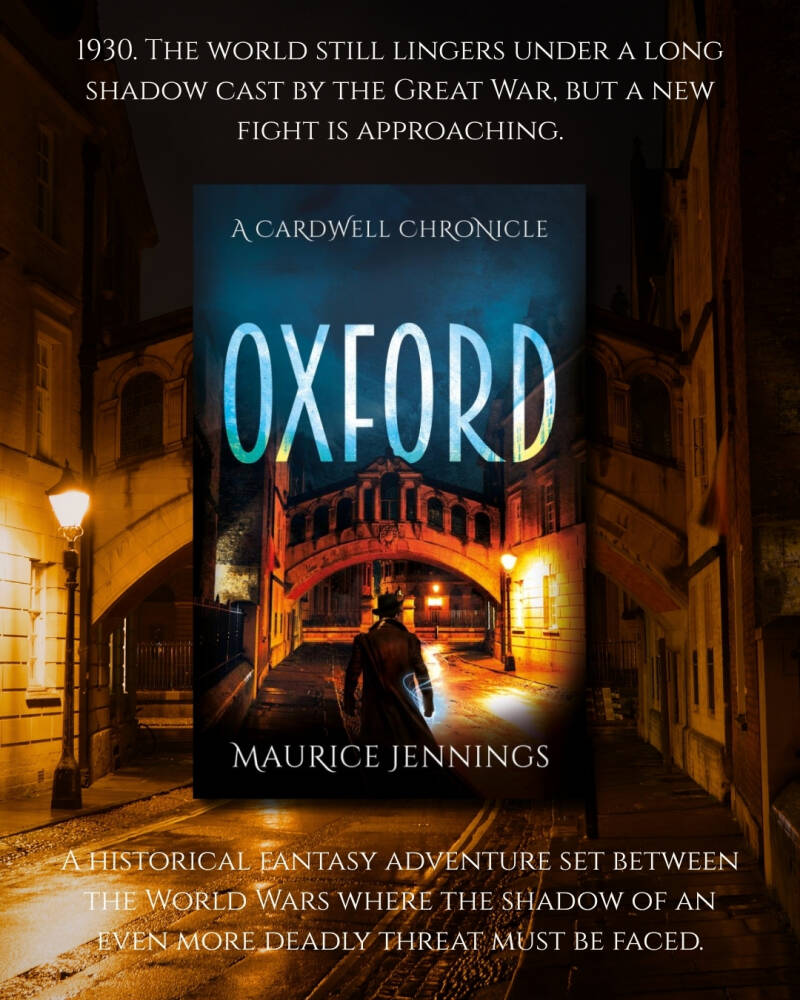
All the various covers for my novel so far.
So it looks like the MFA is not happening. I didn’t get the funding. Disappointed to say the least. My dream just took a step further away. Still, I have to keep moving forward. I have the PhD to apply for towards the end of the year and my liaison at Lincoln University seemed to be quietly confident of me getting funding for my thesis. It was something we discussed for my MFA interview. New plan: finish writing the book I was planning for the MFA, of which I am 35,000 words in, with the first draft of 136,000 words already completed. My aim is Ulster University and the Open University. I will probably apply to Queen’s University, but with my thesis idea and their perchance for Irish nationalism alongside arrogance, I have little chance of getting in there. I’m hoping that having a second novel completed will offer me an opening. Failing all that, I think I will start a history degree, but alternate years between that and writing novels.
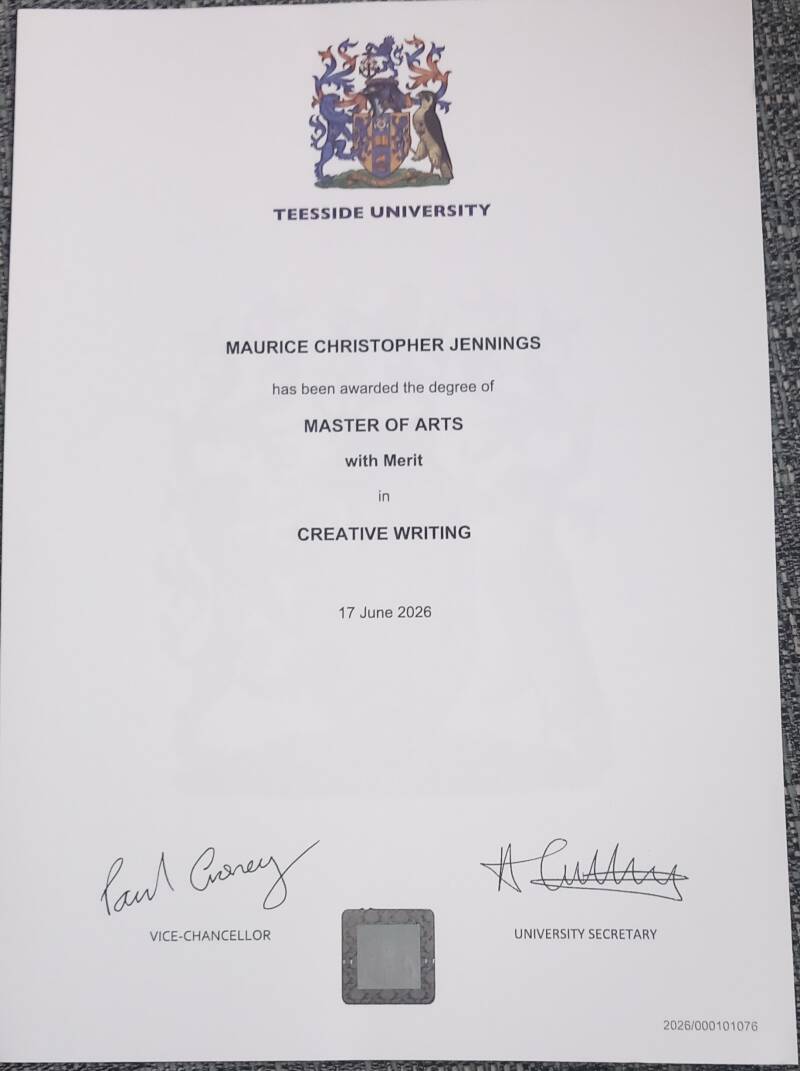
Well, it finally arrived. MFA next if I can get the funding.
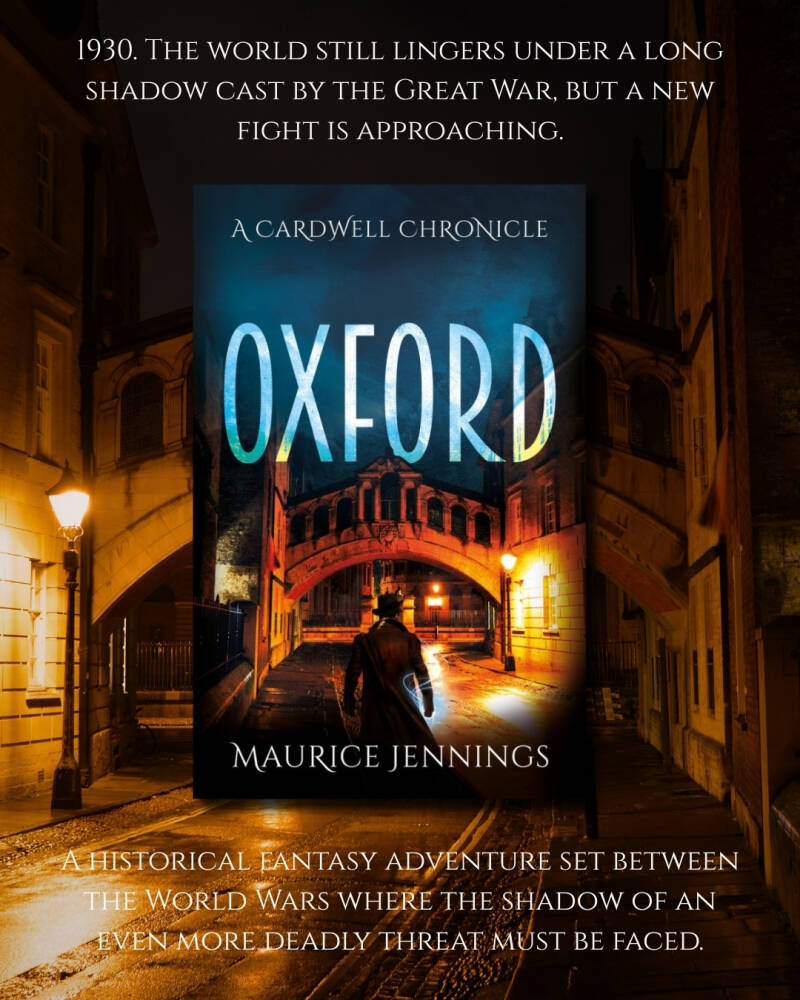
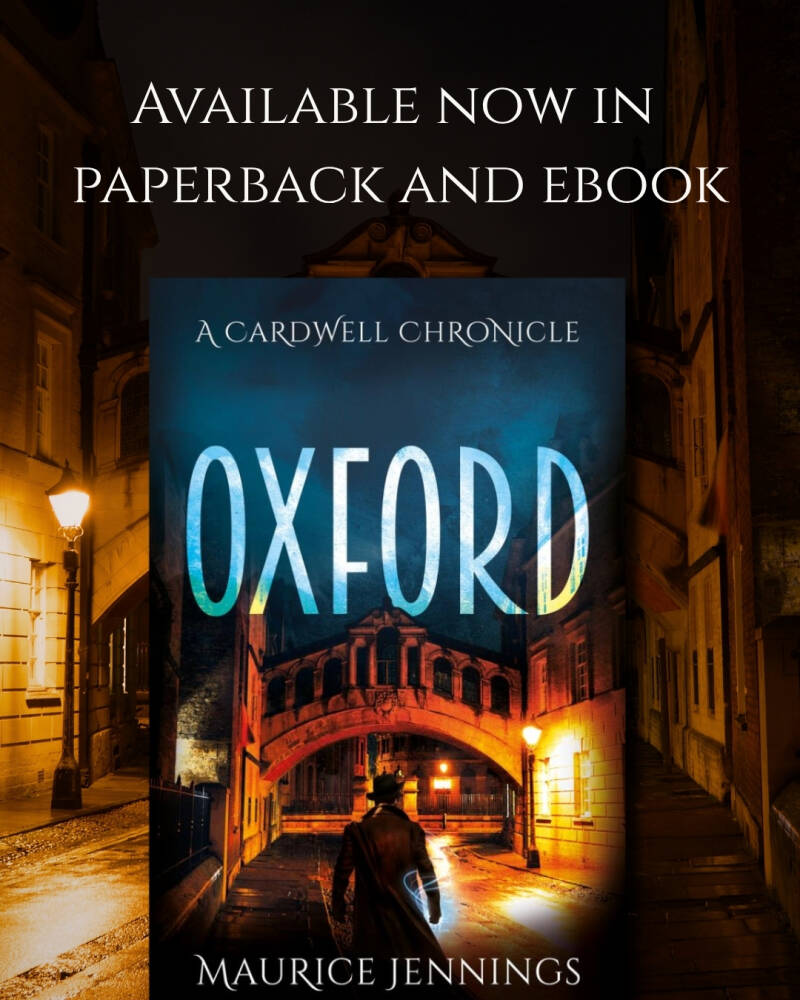
Two images sent to me by my publisher to help with my social media accounts. How amazing are they?
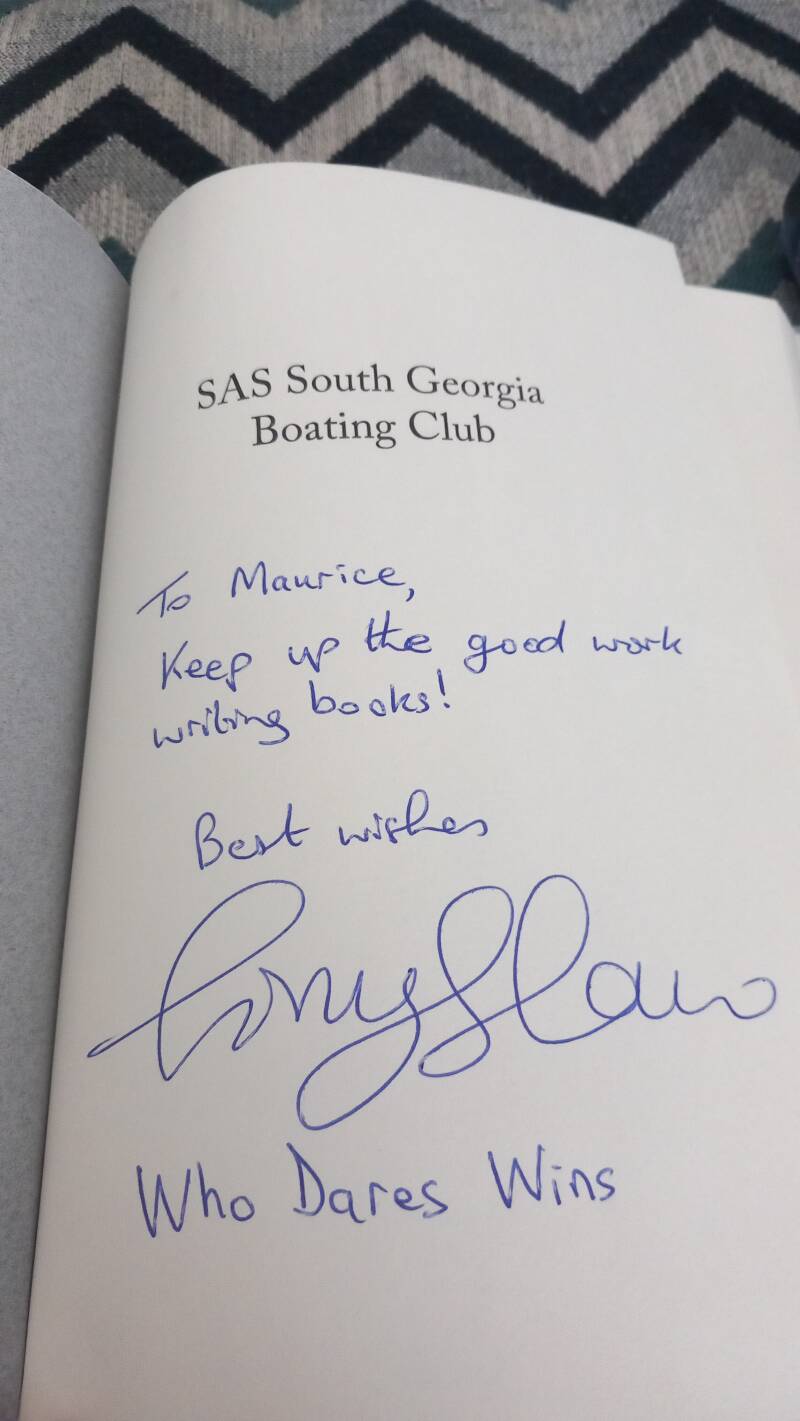
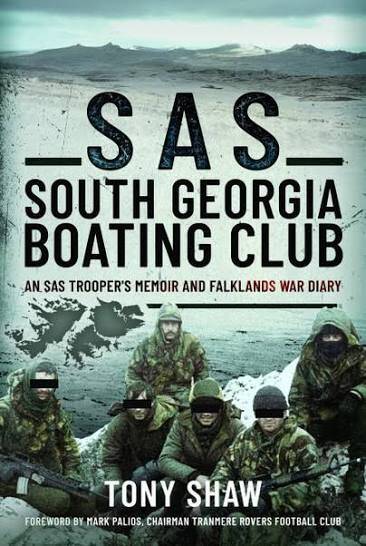
Book Review - SAS South Georgia Boating Club. From the outset, I am going to say I will be a little biased. After all, the author, Tony Shaw, did personalise a copy of his book to me.
What can I say? A man who joined the regular army, went into special forces, fought in the Falklands War, rose through the ranks to become an officer, and educated himself to be multilingual, among other things. Written with little flourish, as a lot of military men do, it simply set out what the author accomplished during those many years, sometimes in diary form. This is what I did, this is what happened, and these were the consequences of those actions, because that was the job, and I did whatever was asked of me without complaint. Of course, such a career comes with sacrifice, which did not stop even after Tony’s military life ended.
Travelling consistently during his time in the Army, it continued when he left, and I have to admit by the end of the book, I felt sorry for him. I have seen it so many times in ex-service personnel, always moving on to the next job, seeking a new challenge or thrill, finding it hard to settle in one place for too long. The jobs he took on in high-risk areas, I am sure, were well-paid, but it was all temporary and he ended up travelling from one country to another until such time it was deemed he was too old for that line of work. His years of service and knowledge did not count for anything in the end, and last working days were spent in mundane occupations back in the UK. For me, the fact that his life worked out by retirement age felt more down to luck than anything else.
Do I recommend this book? For those interested in military history or war studies, or about the Falklands War in general, absolutely.
Perhaps someone can answer my question? I received a review for my book, which had nothing to do with my novel. Oxford: A Cardwell Chronicle is a historical-fantasy with a good dose of adventure, not a book about the historical architecture within the city of Oxford. Did this person just AI review my title without actually reading the blurb or examining the cover? Very, very strange.
Another lovely review and another 5 stars for Oxford: A Cardwell Chronicle. "A fantastic book and a gripping read. It is a thrilling blend of the supernatural, alternative universes, and real historical events, people, and secret societies. Drawing on ancient Irish legends, the First and Second World Wars, and life in Japan and Oxford, England, the story offers a rich mix of mystery, intrigue, and edge-of-your-seat action. I can't wait to see where the author takes the story, how these other worlds are explored, and how the main character develops in future books. With so much history woven together with real-life figures, it is an enthralling and captivating read from beginning to end. A genuine joy to read, I am already looking forward to the author's next book."
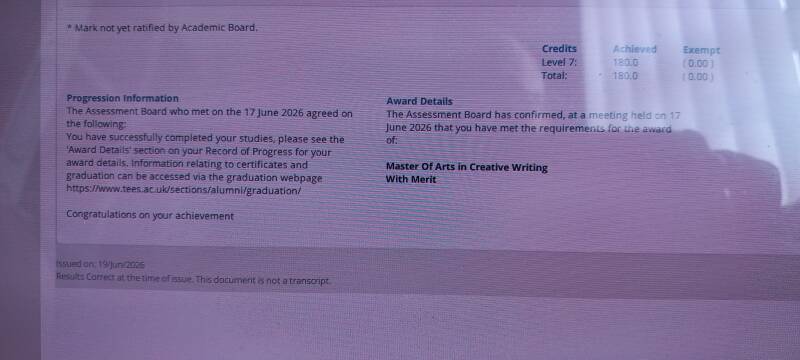
Well, it's official. I have just been awarded a MA in Creative Writing, with a merit grade, by Teesside University. I'm excited to see what happens next.
I was watching the post-apocalyptic series Paradise with my wife, watching the scenes that are set in the underground library, and it suddenly occurred to me, saddened me almost, to think that there would be no more new books to read for that community, no authors to invent stories that might change a generation or even just to entertain or inform. And what would happen to someone like me in that situation? Would I have to forget all I could accomplish?
Another two five-star ratings for Oxford: A Cardwell Chronicle, this time on Amazon. I’m getting there, slowly but surely.
Novel written and released - done.
Master's degree - done.
Application for a MFA and PhD - done.
Let's see what the future brings.
A surreal moment. After studying for two years to complete my master’s degree in creative writing with Teesside University, I have just submitted my final project.
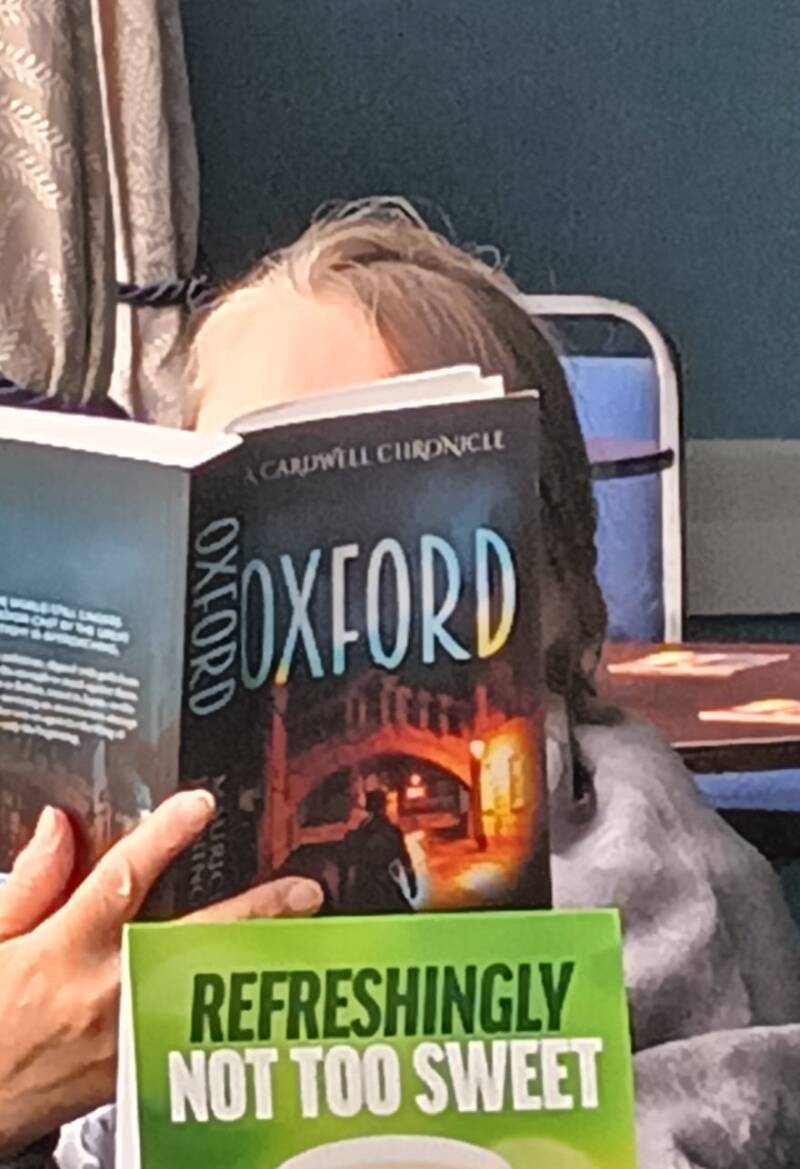
So a family member was out and about today and saw a woman reading the novel I wrote. Nervous and excited about the outcome.
Another 5* rating on Goodreads for Oxford: A Cardwell Chronicle. Frustratingly, there was no review, but I’m grateful to the subscriber who took the time to read it.
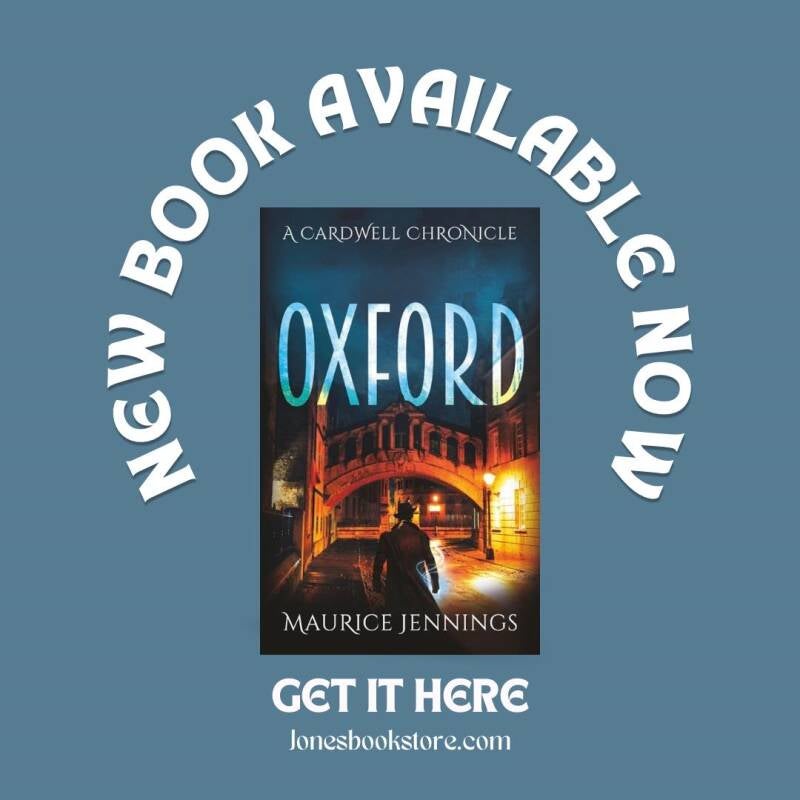
So this happened. When I started marketing my novel on social media, I encountered a lot of sharks, for lack of a better word. Those who take advantage of your desperation. But occasionally, someone genuine reaches out. One such person was Manda Jones, owner/creator of Jones Book Store and an influential supporter of independent authors. I know she is getting something out of it; after all, she too has a living to make, but her prices are incredibly reasonable, and that I now have a platform in America is an incredible opportunity.
Oxford: A Cardwell Chronicle - #67 in an Amazon chart for YA Modern and Contemporary Historical Fiction novels. I'll take that.
Another positive review for Oxford: A Cardwell Chronicle.
What I appreciated most was the reflective tone of the story. It is not rushed or overly dramatic, but instead takes its time to explore the characters and their journeys. There is a sense of growth and self-discovery woven throughout, making it feel more personal than plot-driven.
The writing has a calm, thoughtful rhythm that allows you to settle into the story. It feels like a book you are meant to experience slowly, taking in both the atmosphere and the internal struggles of the characters.
By the end, I felt quietly satisfied. It is a story that focuses on depth rather than intensity, leaving you with a sense of reflection and appreciation for the journey.
What a wonderful review to receive on Goodreads concerning Oxford from one of our American cousins.
*****
Oxford: A Cardwell Chronicle is an intriguing and ambitious blend of historical fiction and speculative storytelling. Maurice Jennings sets the stage for a narrative that feels both grounded in history and expansive in its imaginative scope. What stands out most is the premise.
The combination of post–World War I tension, secret agents, and cosmic elements creates a unique and engaging foundation that promises a layered and high-stakes story. Aidan’s journey provides a strong entry point into the narrative, with personal discovery and hidden truths driving the story forward.
This sense of unfolding mystery keeps readers engaged and curious about what lies ahead. A compelling read for fans of historical fantasy and adventure who enjoy stories that merge real-world settings with imaginative and expansive ideas.
Book Review
Revenge of Rome by Simon Scarrow: In short, Boudica has finally been defeated in battle but has escaped and gone into hiding. Eventually safe, she recruits once again to continue her fight against Rome. Meanwhile, Prefect Cato has been tasked with hunting Boudica down and stopping her. Told largely from Cato’s POV, the novel touches on the history and politics of the time, with Cato’s personal and military worlds overlapping.
The following is a brief review and my standout bits, but of course, everyone is different, and I will do my best to be purposely vague concerning the plot.
So where to start with this one? For background, I have read several of Scarrow’s novels featuring Cato and Macro, but this is the first one where I wondered if he wanted to write this particular book. All the way through, almost towards the end, I kept asking whether he was pushed to do it by his publisher, just to get another novel out there, or was he simply bored writing about the same two characters.
Examining the cover, it was dramatic, informing accurately what you will get within the novel. But the sub-line, ‘Rome and Boudica. A duel to the death.’ Really? Boudica, a rebel leader in a small, backwater country against the might of an empire that stretched from Western Europe to the Middle East and all the resources that came with it. Was the historical Boudica an annoyance? Yes. Was she an inconvenience? Yes. But a duel to the death against an empire? Hardly. If it were I, I might have said something like — ‘Boudica and Rome. A heroine’s stand against tyranny,’ or words to that effect. Though if you know the history, that might make Boudica’s story even more tragic.
The writing, especially at the start of chapters, the paragraphs were so long I was reminded of reading a textbook back in my school days. What he could have done, what I do, is yes, draft the opening scene, but allow the dialogue to give the reader the relevant information they needed, which would have also added action to the scene. But Scarrow did not bother with that, giving me the perception of just wanting to get these chapters done.
Another irk for me was when the Roman ship captain, Besodius, said the line, ‘Amen to that’ (apologies, but I forgot to note the page). My degree was in Classical History, and as a history buff, it slightly annoyed me to see a modern idiom in a world set in 60AD. The word ‘Amen,’ a Christian term with Hebrew roots, is out of place in a world where Christianity was still a cult and largely settled around the Middle East. Of course, if Besodius was shown to be a secret Christian later on in the novel, I would have ignored the line. But alas, no!
It was not until Chapter 24 that a change of tone finally happened, but whether it was Scarrow finally enjoying what he was writing or if he realised he was nearing the end, I could not say.
In Chapter 29, Cato and Macro were in a situation. The predicament was written in a convoluted way that made it hard to understand. I know Scarrow had an idea in his mind, but I have to ask if there was a simpler way of writing the scene. Looking at the options available, Cato offered a remedy to his men, but the way it was written is often seen in television series or films. Main character — ‘Okay, this is what we are going to do.’ — before it fades to black and cuts to the next scene. I could almost hear Boudica muttering later that immortal line from the Scooby-Doo series — ‘And I would have got away with it too, if it wasn’t for you pesky kids.’ It just felt like lazy writing by skipping the explanation. All Scarrow had to do was give a brief, simple line — ‘What we are going is lash the ships together’ — or offer some sort of other commentary.
It was not until Chapter 30, before Boudica and Marco finally talk. I found the conversation emotional but predictable, and I imagine Scarrow enjoyed writing it after so much describing a run-of-the-mill military campaign. That said, it went the way I had hoped, though the plot could have turned darker if Scarrow had so wished.
So what did I think by the end? In short, Revenge of Rome was lacklustre, predictable and, to a certain extent, felt rushed. I found the characters two-dimensional and matter-of-fact in dialogue. Cato, speaking with the newly-promoted Governor Classicianus about a near-miss incident he had in battle, fell flat with me. The novel ended exactly as I predicted it might from the very start, with Scarrow missing an obvious chance to mix it up. Still, if you enjoy these novels, you will still read Revenge of Rome, for if more are written in the future, it is another notch in the lives of these two warriors.
One of the most surreal moments of becoming an author is when people, strangers, ask me to sign a copy of my novel. I look at them, hold the book, know that I wrote it, write the words, and yet it does not feel real. I wonder if I will ever get used to it?

What an unexpected present! A pleasant surprise from my publishing house, Troubador Publishing Ltd. A small gift, but a thoughtful one, and one that had the effect of lifting my soul. Thank you, guys.
For my MA final project, I had to show the first several chapters of a high-fantasy novel. It is an idea I plan to follow up on for my MFA. For the academic examination of those particular chapters, my genre and prose, I had to investigate several iconic British and Irish authors like David Gemmell, Lord Dunsany, J. R. R. Tolkien, and Robert Holdstock. What surprised me the most was that C. S. Lewis was like-minded in where I drew my ideas for this specific project. Who knew? To be honest, I could not ask for a better iconic literary role model.
It is funny how things develop. I have published my book now (out on the 28th April) and a guy who used to teach me martial arts got in touch about wanting to write his own book. He has to go into hospital for a serious but routine operation, and he wanted to write it over his recovery period, which might be months. He was looking at apps and programs, worried about his grammar and spelling, and wondered if he was good enough to take on such a project.
What I said, what I would say to everyone, is just write the book. That is the hardest part. Things like grammar and spelling can be sorted out afterwards. There are plenty of programs out there to help with that. Just look up the basic layout of a manuscript and worry about the story and how it connects with readers. To me, for me, that is the most important aspect. Believe in yourself. Stick to your plan. Keep moving forward.
So where to now? Oxford is done and set to be released on the 28th of April. My master’s degree is practically done. But it is important to keep moving forward. Foolishly, I assumed that applying for PhD funding was very much like what had occurred over the past several years, but I was wrong. The application for financial aid had to be submitted before Christmas, so now I am looking at an MFA in Creative Writing and Publishing.
The pros: 1) A novel has to be written (which I’ve already started). 2) It puts me in direct contact with publishers and literary agents. 3) It would allow me to become a lecturer. 4) It gives me time to apply for PhD funding. 5) By the end of the MFA, I will either have a traditional publisher, or I will have my second novel published again with Troubador. 6) Being called Associate Professor or Professor Jennings. How strange it is to even write those words.
The cons: 1) Another year before I can start my PhD, if I go for it, but at least the time won’t be wasted. 2) I can never be called Dr Jennings until I have a PhD.
At least my small dream of having a literary life won’t be for a lack of trying.
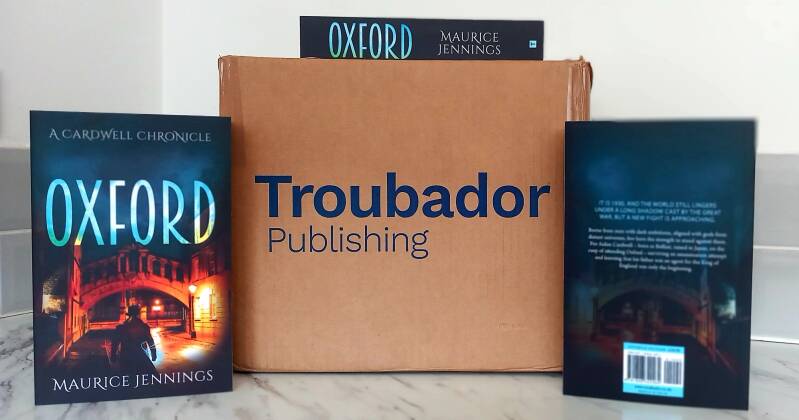
So, the rumours are true. Look what arrived at my door. Roll on the 28th April.
It must be real after all. I'm on Amazon
www.amazon.co.uk/Oxford-Cardwell-Chronicle-Maurice-Jennings/dp/1806342464/ref=tmm_pap_swatch_0?_encoding=UTF8&dib_tag=se&dib=eyJ2IjoiMSJ9.EXmWKXg3CsQsj2sVIoifDghtOCf3FmCDqSCwLnGw31kjoXhD2ReBpUHOFKoWEHX8bkAS1FyKw_WjvjcntLuBMwseRscDmodncbVNcOQQRck.zSDLgCqADo16znAc9dJp1MRK6AKKJIwNtWVfL7oOsiI&qid=1773864551&sr=1-1
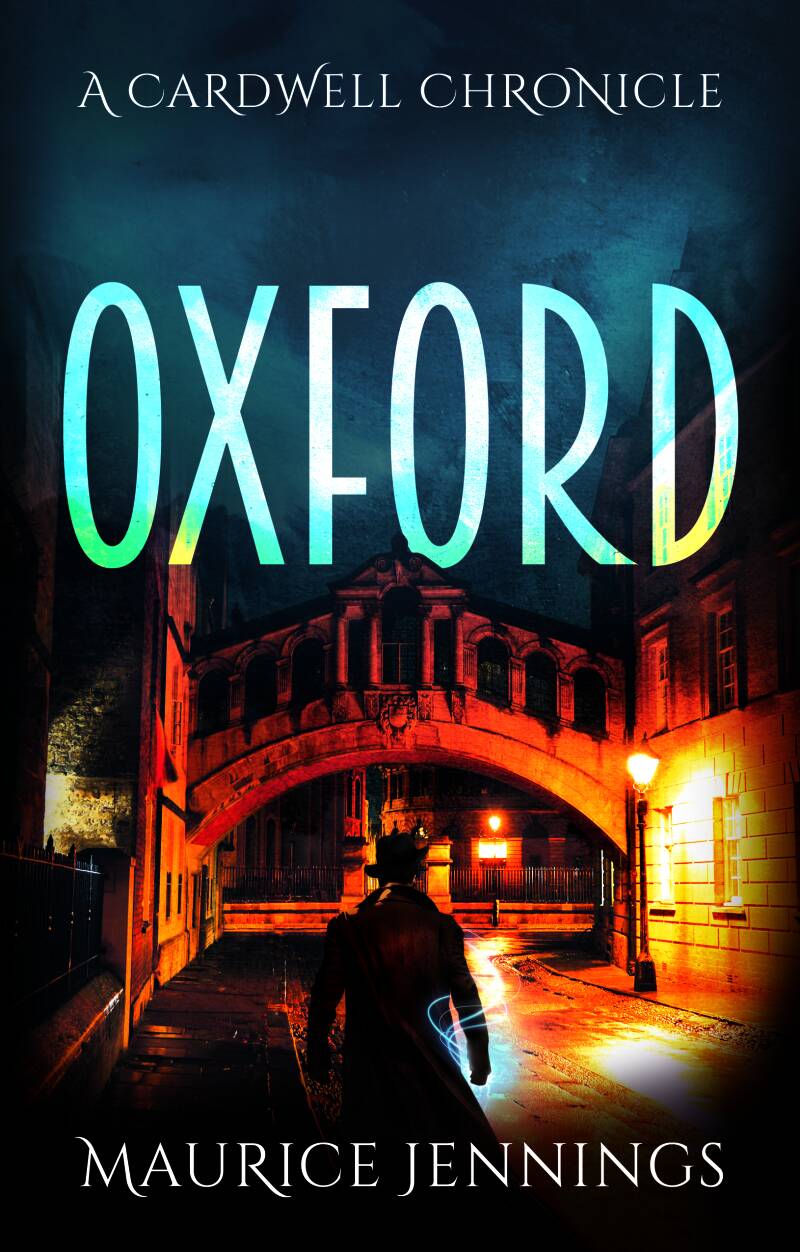
I am truly lost about the direction I should take, factoring in my age. On the one hand, an MFA, which is only a year but expensive; on the other, a PhD, which is longer but comes with more prestige and is specifically geared towards research and lecturing. With an MFA, both things are also possible, after all, my own creative writing lecturer during my degree only possessed an MFA, but more and more universities are now asking for PhDs. Of course, there is a possibility of lecturing while undertaking a PhD. If I were still in my early twenties, I would go for the PhD as time would allow for it. I think my only course of action is to undertake an MFA, to follow the path I set before myself, and then go on to a PhD, but even as I write this, I am still unsure.
On the other hand, Oxford is now complete. The paperback and eBook are set for release on the 28th April. I’m assuming the marketing will take place beforehand, specifically the four weeks leading up to its release.
So I finally got my wife to read my final assignment for my MA. Her response: I didn’t know you were so clever.
I’m not quite sure how to take that?
I bought this book for my MA final project. It’s amazing when doing something like that: I buy a book, only to read a few necessary chapters, only to use a few lines. I patted myself on the back, thinking how clever I was, but when I discovered this book, I thought it answered the question I posed in my final project. I felt frustrated. Was every academic idea I considered already taken? Only it didn’t. It touched on it, supplied some of the information I needed, but it didn’t cover the actual point I was making for my MA. Does that mean I have found a possible nuanced idea that hasn’t been covered, one that would call for research into the military history, general history, and religious history of Britain? To be honest, it would take a lot of research to undertake such an academic book, and who would buy it if completed. But maybe if I were to offer papers for academic journals, I could eventually band them all together and turn them into a book. Of course, that all depends on whether I continue my academic journey.
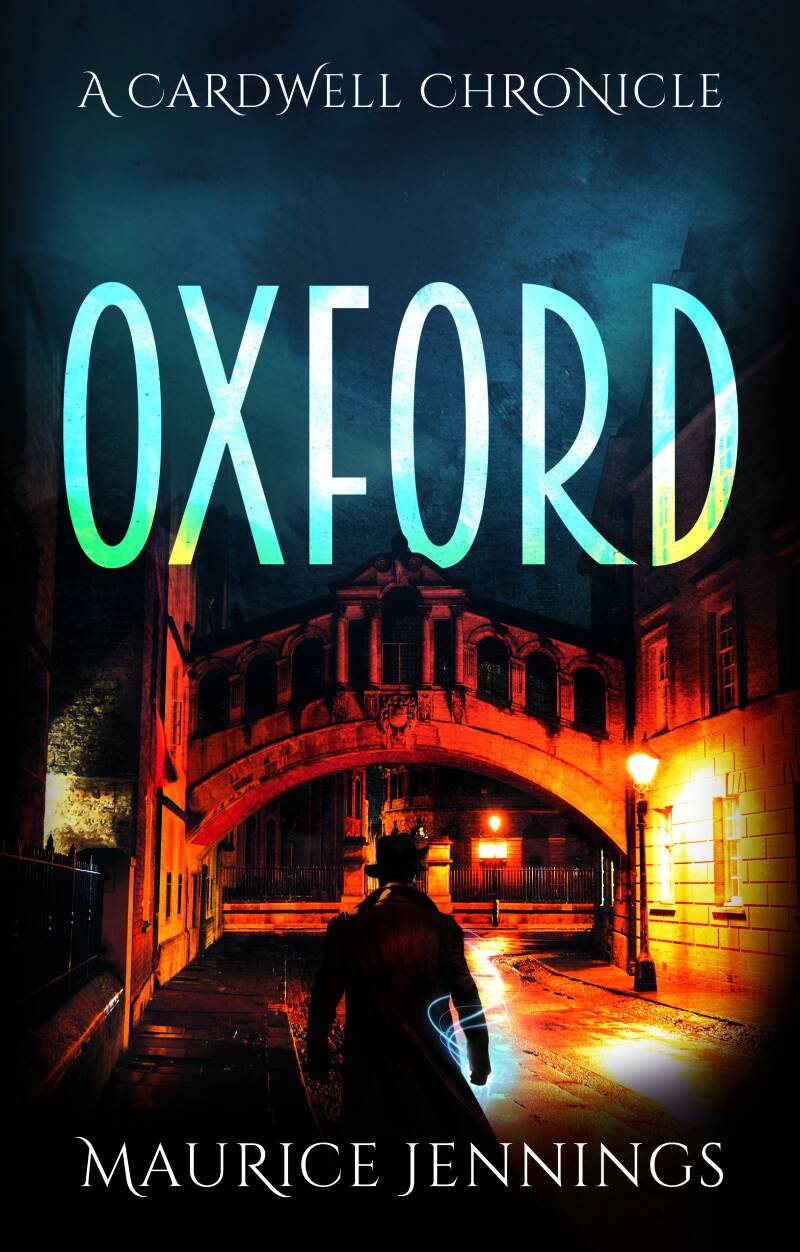
It is 1930, and the world still lingers under a long shadow cast by the Great War, but a new fight is approaching. Borne from men with dark ambitions, aligned with gods from distant universes, few have the strength to stand against them. For Aidan Cardwell, born in Belfast, raised in Japan, on the cusp of attending Oxford, surviving an assassination attempt and learning that his father was an agent for the King of England was only the beginning.
Well, it's been a while, but here is my book cover for my new novel, created by Troubador Press. It is pretty much what I had in mind, as it instils, hopefully, the right theme for the story that is inside.
As for everything else... I think I have been a bit obsessed with finishing my final project for my MA. But now that is done, what do I do next? I have already started a new novel, and for a MFA, that is what I have to accomplish. So, in theory, come next year I would have an MFA in Creative Writing and Publishing with another novel released. If I go down the PhD route, would I have to wait until it was completed before I released another book? I guess it really comes down to what I score in my MA.


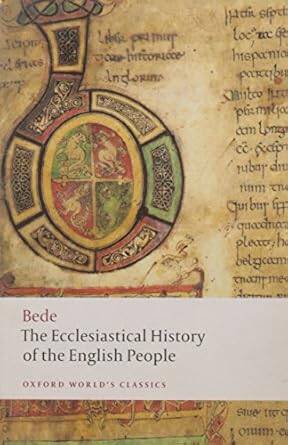
Just some of my books for my Creative Writing MA. Little did I know, when I first began my course that I would be examining early medieval British history as part of my final project. Thankfully I love history.

So I’ve finally finished Requiem, written by Robyn Young. What to say? It was okay. The funny thing is, I think I have read it before. Aspects I recall; others I did not. Robyn is a successful author, yes, but what do you say about a novel you don’t remember reading the first time? Enjoyable but forgettable — again.
My thought of the day: as technology builds and becomes ever more powerful, does our sense of a national identity diminish to become one that is global?
Another merit score on my last assignment, but I really don’t know if the idea of a PhD is for me anymore. It would seem any primary sources outside of academia are not as good as an academic one. Facts are facts. It doesn’t matter where they come from. MFA it is then.

Bought this book on a whim, thinking about my future PhD project. Perhaps not exactly what I was hoping for, but it is still a pretty interesting book.

My new book, as suggested to me by my project supervisor, to help with my final project for my MA. Perhaps I have bitten off more that I can chew.
Book is estimated to be available from the end of May 2026. That is about the same time my MA ends. Exciting times ahead.
So, Writing Specialism assignment for my MA done - check. One more assignment (the final project) and that is my MA done. What next though - MFA or PhD? Book development started within Troudador Publishing - check. Let's see what the future holds.
So here I am during silly hours, working on my penultimate assignment, fixed around my writing specialism. The literary section is almost done. Now I just need to worry about the academic critical commentary that goes alongside it. My cousin once told me that when he was doing his MA, towards the end, he just couldn't wait until it was finished. I kind of feel that now.
Well, after a hiatus, I’m back. I should explain that when I started this blog, I was off work with a broken ankle. It was probably the best thing that happened to me. First Christmas in years that I fully encompassed. It allowed me to fully take on writing fully, to indulge my interests, start a blog and some social media, and finally, to study. But after Christmas, I went back to work. A lot less free time since also going back to studying for my MA. Then, when that particular module was completed, I threw myself into completing Oxford. So where am I now?
Oxford is done and sent to Matador Publishing. I am now awaiting word on want they think. After my summer break, I am now studying again. One more module and then my final project and my MA is complete. I think I’m on track for a merit, so my next option is, if I continue on for an MFA or a PhD. I’m a certain age now, and a PhD is several years. MFA is shorter and might still allow me to teach at the postgraduate level, but it focuses more on writing rather than academic research. Though to be honest, that appeals to me too.
I got asked the question about our favourite autobiography/biography in my MA class. I know I'm going to get lambasted for this, but I don't read autobiographies or biographies because, simply, I'm not interested. I really feel I need to explain all this better, but I just know I'm going to come across as shallow, but this is my personal view.
Everyone has a sob story. Everyone has been hurt, suffered loss, cast adrift, or whatever. You see it even on X Factor when they sing the song in memory of a budgie, they lost two years earlier or whatever. Life moves on; the world continues to turn. And yet, some feel the need (perhaps to fuel their arrogance or their publishers) to set their life stories to books for a price, to tell their tale of overcoming hardship when there are probably ten thousand people across the world with that same story, or worse ones, and no one will ever know their names. I have no doubt that if you could hear all the stresses, hardships, and worries of humankind, the world would be deafening.
You have the rags-to-riches story. I don't need the story. His/her life experiences aren't mine, but I would happily read how they got from poor to rich in ten easy steps. I don't need to hear about a person's life and the path they took to better themselves. I just need to know how they bettered themselves. I am a student of history, but all I want are the facts, the causality between the beginning and the end. I don't need the emotion behind events unless they are relevant to the historical content.
I read an amazing book, No Way Out, concerning Major Jowett holding a PB against overwhelming numbers of Taliban in Afghanistan. Think Rourke's Drift or the Alamo for those who are military minded. It was a fantastic story of bravery, brotherhood, and loss, but I didn't need to know about his life story; only what he did in that situation was what really mattered most.
(My wife reads autobiographies/biographies, but she'll admit she's nosy. Take out of that what you will, lol.)
I came across the piece when reading by Jalarth Benson, 2018, An introduction to group dynamics and process, in Working More Creatively with Groups, Milton: Taylor and Francis Group, when reading about writers in the community and their wellbeing, concerning The Anti-group Phenomenon. The oscillating tension between the approach-avoid, attachment-separation dynamics of the love and will polarities in human interaction means that groups can sometimes create more problems than they alleviate. Nitsun warns against an over-optimistic and idealizing view of groupwork with the formulation of his concept of the ‘anti-group’. 21 He asserts the anti-group is a broad term ‘describing the destructive aspects of groups that threatens the integrity of the group and its therapeutic development’. An introduction to group dynamics and process phenomenon is really ‘a set of attitudes and impulses conscious and unconscious that manifest themselves differently in different groups’ and has three main sources:
• Resistance to participation in groups stemming from distrust, fear, anxiety and dislike of groups.
• Aggression and hostility arising in the group that not only threatens interpersonal cohesion but is aimed destructively at the ongoing life of the group itself.
• Accelerating destructive processes that could not be contained in the usual way.
I have described a psychotherapy group meeting in Belfast at the height of the ‘Troubles’ that was composed of several disturbed and aggressive individuals who believed that the group opportunity was a substandard form of help and continually agitated for individual treatment. Their hatred and contempt for the group was hard for the beginning and untrained therapist to bear and when the premises in which the group met was destroyed by a fatal bomb explosion, a spiral of destructive forces was unleashed in the group that led ultimately to the complete breakdown and dissolution of the group. While the therapist could just manage the hostility of the group before the bomb explosion, the massive disintegration of the external environment seemed to activate an equally massive disintegration and fragmentation in the internal and interpersonal world of the group. The implosion of the group was an inevitable consequence of destructive anti-group forces amplified by the environmental trauma. In this example we can identify several determinants of anti-group behaviour:
• Poor selection of members – too many highly aggressive members.
• Poor preparation for group – not enough attention paid to members’ anxieties and distrust of the group modality including the misconception that group treatment is second best to individual work.
• Flawed development of the group.
• The group therapist’s lack of training and lack of support.
• Group operating in a situation of civic conflict.
• A sudden group crisis that could not be managed.
An anti-group dimension is a natural part of the development of all groups (see Chapter 2) and can be understood and managed and even transformed. The group worker who accepts that conflict is a central feature of group life and is attuned to aggressive and
destructive forces are much more likely to be able to manage and channel these processes than a worker who is frightened of conflict and seeks to avoid or deny their presence. Rather than endeavouring to inhibit the expression of conflict the creative group worker realizes that hostility is a sign of hope and anger, often initiates change, and prepares the way for forgiveness and reparation. The following chapters all contain useful suggestions and strategies for contextualizing aggression and utilizing and reframing the positive value of hostility.
All I could think was, welcome to Northern Ireland.
I came across this article in The Guardian, dated 30th December 2024, about the rewriting of classics for modern sensibilities. My first thought was, could they not write something original? Why not just write something new instead of directly stealing from a well-known novel? Then for the copycat author to stand smug and self-righteous at their virtue signalling.
One such book was James, a reworking of Huckleberry Finn by Percival Everett. It was the unofficial book of 2024, topping best-of-the-year lists and winning the prestigious US Book Award for Fiction, yet it still lost out on the Booker Prize. I have to wonder, was it because it held a slave within it? Like it or loathe it, Huckleberry Finn was considered to be one of the most significant novels in American literature. Hemingway considered it “the best book we’ve had.” It was also controversial and one of the most banned. A new edition, with racist terms removed, was published in 2011. The New York Times complained that “there is no way to ‘clean up’ Twain without doing irreparable harm to the truth of his work.” May I suggest those who don't like reading novels from their time shouldn't read it? Remind me what the Nazis did with the books that went against their doctrine.
Its success followed that of last year’s women’s prize-winning (at least it wasn't gender-neutral) Demon Copperhead by Barbara Kingsolver, a 550-page updating of Charles Dickens’ David Copperfield, which transported to the author’s home region of Appalachia during the 1990s opioid epidemic. As the supreme chronicler of social injustice, Dickens provided Kingsolver with “a masterclass” in how to use narrative to make readers care about a latter-day underclass (which used to be the working-class).
This trend for repurposing famous canonical works is set to continue into this year. Call Me Ishmaelle by the Chinese-British writer Xiaolu Guo transforms the American behemoth Moby-Dick into a feminist adventure starring a cross-dressing female sailor (sigh). Guo describes her novel as “a homage to an American master, but with transgressive twists.” All three of these masters were white men (sigh, sigh). Dealing with issues of race, social injustice, gender, and our relationship with nature, each of these reimaginings of 19th-century novels gives a new slant on the contemporary American crisis. Oh my God, why can't people stop attacking Western culture and look to other parts of the world?
Recent edited versions of novels by Roald Dahl, Agatha Christie, and Ian Fleming have met with similar accusations of censorship. That is exactly what it is: censorship. By rewriting, rather than simply removing offensive language or storylines, it doesn't confront problematic texts but rather buries it, instead of learning from it. By changing the perspective of a novel, marginalised figures can be turned into the heroes of their own lives, to paraphrase the opening line of David Copperfield. Everett rescues James from the racial stereotypes of Twain’s original, giving him back his proper name, depth of character, and literacy. “With my pencil I wrote myself into being,” James says. But they weren't the novels written by Charles Dickens or Mark Twain.
From Jean Rhys’s landmark postcolonial and feminist prequel to Jane Eyre, Wide Sargossa Sea, in 1966, to Sandra Newman’s Julia, a powerful retelling of Orwell’s Nineteen Eighty-Four published last year, overlooked female characters are also being written into existence. Unsurprisingly, ancient myths have proved fertile territory for female-led reboots, with Margaret Atwood, Pat Barker, and Madeline Miller all going behind the battle lines of the Odyssey and the Iliad.
None of this is new. Shakespeare drew heavily on classical stories (Romeo and Juliet is based on Ovid’s tale of Pyramus and Thisbe). In turn, there are no end of Shakespeare-inspired offshoots. This is justified by saying, 'All storytelling is retelling,' which is true, but please try to come up with some originality. It goes on to say that returning to old books is not a failure of invention but a way of keeping the canon alive, but that is untrue, especially when modern political liberal values override the story. Whether the contemporary authors stick faithfully to the plot line (as Kingsolver does) or play fast and loose with the original (like Everett), they are unlikely to breathe fresh life into these characters and stories. The Guardian says, 'At their best, reworkings like James and Demon Copperhead are future classics in their own right.' Well, that remains to be seen, but I am pretty sure that most people really don't give a shit about liberal agendas. They want escapism, not morality lectures. It's no wonder the numbers reading novels are dropping.
I was shocked to learn that in a Guardian article by Kit de Waal, she quoted a 2016 paper, published by Dr Dave O’Brien of Goldsmiths, that it was estimated that almost half – 47% – of all authors, writers, and translators hail from professional, middle-class backgrounds, compared with just 10% of those with parents in routine or manual labour. This analysis, of the 2014 British Labour Force Survey, also identified that 43% of people working in publishing, including those in the influential editorial roles, were from middle-class origins, with only 12% from working-class backgrounds. Does that mean the talent pool in working-class backgrounds does not rise to the same levels as those from the middle-class or is it really all about networking? Perhaps self-publishing is truly the way forward. At least then I would be in total control in all aspects of my novel, such as when I published Meuric as an eBook, which I enjoyed.
What is the job of a writer? What do they do? For me, writers essentially create content for a designated audience with additional nuance for the reader. This can include advertising and marketing, book writing (including fiction and non-fiction), journalism, poetry, proofreading and copyediting, research, screen and scriptwriting, teaching, technical guides, and web design, to name just a few professions. It is estimated that jobs for authors and writers will grow 4% between 2021 and 2031.
Well, I did it again: I bought a book on a whim - The 39 Steps by John Buchan. My wife's not going to be happy (again). But then again, was it just a fleeting fancy? I have always been a fan of the movies and regularly wondered about the novel. I couldn't tell you why. It was just that old-fashioned spy caper with a mystery to solve. There's nothing fancy about it, but was popular enough to keep having remakes done, and I only just learnt that it was the first in a series. The author had a pretty interesting life also. A Unionist Scot, during his life he was a barrister, historian, journalist, novelist, politician, and he served in both the Second Boer War and the First World War, the latter in military intelligence. That was most likely the basis for his hero Richard Hannay and why he fled to Scotland in that first book.
An interesting thread today: how do you feel when you write? This is a pretty interesting thread for me. There is so much in the way of emotion, and as always, as probably most writers, all of it is internalised. Well, maybe my wife understands and my children to a slightly lesser extent. It reminds me of a book I'm reading at the minute, First You Write a Sentence by Joe Moran, which is almost like a philosophical discussion about being a writer.
For me, it is a passion, a drive, to get my voice out, to bring those story ideas I have whirling around in my mind to life. I can't tell you where it comes from. Certainly no one in my family is that way inclined. I feel joy as a story takes shape, but if I'm not careful, for me, it can become like a drug, and I would write all day to the detriment of everything else. I can't tell you the number of times I've received a stern word from my wife for running late because I was writing.
Writing comes easily. I don't mean to brag, but the issue for me is stopping; when enough is enough. I have my favourite themes, but I can just about write just about anything. In my BA I wrote a poem. Then I started thinking that I had to change it, tweak it, because that's what my tutor, whose speciality was poetry, wanted to see. It turned out that the first draft was my best work.
When I write, sometimes it feels like it is someone else penning the words, and that I am merely a vessel. When my wife reads my stuff, she can't believe it's me (I haven't decided yet if that's a compliment or an insult). I don't talk the way I write. That might be an interesting point for us to discuss later.
Once I wrote a scene where I killed a character off in cold blood, and it affected me physically. On another occasion, I was in the kitchen, radio on, writing when my girlfriend (now wife) came in asking what happened to the station. At some point it had become static, and I was completely oblivious. I can become so single-minded that I've seen myself sit in the living room surrounded by my family, the TV on, and I could zone everyone out.
Funny story: I once wrote a battle scene in the kitchen, the big finale of my first novel, and all the while my daughter was telling me about her day, my wife was making dinner, and the music was blaring. I got it done and later found an American publisher (who lied about everything, but that is another story). So distancing myself from them, I sent my manuscript off to have it critiqued by someone independent. She remarked that that particular battle scene was one of the most exciting she had ever read. But to be honest, the damage was done, and I gave up writing for a number of years. I guess writing can also be heart-breaking.
It can also be frustrating. I have constant ideas. I can write. I'm not one of those smart literary people, but I think I can develop stories that capture people's attention and imagination. I believe that is where my strength lies, yet it doesn't matter how much praise I get for my work, I can't break into the world of authors. But then you see famous people promoting their most-likely-ghost-written, books I think to myself, it's not fair.
But I'll never stop. I can't.
Just read an article by the psychoanalyst D.W. Winnicott in Playing: a theoretical statement, who compares children playing and exploring the fantastical alternative realities with writing. Here are my two-pennies worth.
All writers play, but internally, especially when it comes to fiction. Think about characters, location, plot, twist, dramas and conclusions, and all of it without a sound, stored within our minds, twisting and turning, whereas children are free to express themselves with no real thought to self or ego. They display their story by action, while we write it after formulating the plot, exploring the fantasy of genre writing in relative silence (with copious amounts of tea). But maybe play is the wrong word. Maybe when it comes to writing, it is more like a game. When I write a historical piece, the game is how to conjoin all the facts with a fluid narrative. But it made me see the overlap between writing and playing.
(I) When Winnicott called the child playing all-consuming, we might be called single-minded.
(II) Their playing takes in an exaggerated world, and so do our stories, but within the mind.
(III) The child gathers objects or outside influences to push a fantastic, alternative reality, and so do we. How many of our characters are based on real people? How many locations have we travelled to that have inspired our plots? Even the societies we have grown up in have directed our thoughts. I grew up in Northern Ireland, and I find a lot of my stories have both Irish and British influences, whether it be history, legends, people, or settings.
(IV) And lastly, Winnicott says that ego disrupts play, which is true. You watch as children grow, their playing fades away. Imagination is replaced by objects, and children become increasingly aware of societal pressures on how they are expected to behave. I guess writers are lucky in that sense, as all our fantasies are in hidden silence until we set words to paper. But our disruptive ego, I believe, comes from self-doubt. Is our writing good enough? Are the worlds we try to invent nonsense? Is the story palatable? I share all these fears, but what I do know is that the art of selling fantastical narratives has been around for thousands of years and will hopefully last for a few thousand more. Well... until AI replaces us all.

Ever since I read David Gemmell's Dark Prince and Lion of Macedon, I wanted to write a book about Philip II and his son Alexander the Great. Though fictionalised around general Parmenio, who loyally served both men, I came away thinking that if it wasn't for Philip, Alexander may not have achieved such military victories or conquered such vast swathes of land. It was my dream to write a novel about them one day and to make sure that Philip got his just dues. Unfortunately, Adrian Goldsworthy got there first, but what a book. Well researched, informative, easy to read, and best of all, he had Parmenio all the way through it too, which gave me a thrill. In my modest opinion, he is a man who deserves his own book, but as he was always in service to his kings, he was destined to live in their shadows, even if the true achievements were his. I've seen other review the book as necessary for military history enthusiasts, but not so in my consideration. Classical history lovers and fans of Philip and Alexander would greatly enjoy it but there are no real descriptions into the military tactics and stragesties used.
Recently I read two articles about writing about the self. The first was by Hunt, Celia & Sampson, Fiona (2005), Writing: self and reflexivity. To be honest, it was a long-winded piece talking about how to write an autobiography, about putting ego to the side, about the humanist view of things and its history right up to modern times, and the true version of the true self, and I came away wondering if this article was actually about writing or about philosophy and psychology. It wasn't until I read A Novelist on Writing the Self by Mridula Garg that things clicked. Her view was much more direct and simplistic. The first was you simply can't write a true account of yourself. Ego doesn't allow for it. Her second point was that the only way to be truly honest was to write a fiction around it; you hide your true self within words. But while reading the article, when Mridula called all writers amateur psychologists, I instantly saw the connection with the previous article, and it made me think, writers are amateur psychologists. We dictate what our characters do, what they say, and how they react.
I have just read an online article about Katie Ward and her mentorship under Hilary Mantel. A struggling novelist at 27, she had 43 rejection slips when on the 44th one, she was asked for her manuscript. And even that was turned down. How crushing that must have been; still, it is reassuring to know that even an award-winning author such as her had to fight for her place and show resilience. After speaking with a friend, she was put in touch with Hilary Mantel of Wolf Hall fame, who took her under her wing and bestowed upon her some structure in writing. Out of them all, I think the strongest lesson is to have belief in oneself, to keep going, and to have faith in one's work. To look at my life objectively, I'm a middle-aged guy for the first time trying to become a traditionally published author. What am I thinking?! I have even been told that I am too old to do anything new. But I'm lucky. My wife believes in me, my kids, and even my closest friends. So I'll never stop trying.
So I've been asked to complete a survey for my MA. Oh my God, I wish I had gone for the 14 months course and not the 2 years. I have sitting on my laurels for a few months now and it is just dragging on. Maybe because I've completed my new novel and my proofreading course, I'm just eager to get on with more things.
So I've sent my manuscript directly off to a publisher for the first time. Probably not a good idea not gaining representation, but we'll see. Just a shame I have to wait possibly up to six months for a reply.
Well that's my Proofreading and Editing course done with the College of Publishing and Media, finishing with a distinction. I'll probably have to wait until after Christmas, but hopefully it will lead to something within the writing world.
So ITV has gone and applied for an AI innovator with a wage anywhere between £80-95,000 to work on character development. Is that what the future is to be for writers? To be outsourced to a computer program, making passion, originality, nuance, inspiration, and role models for future generations a thing of the past. If Shakespeare were about today, would he too be replaced by AI? Would JK Rowling, Stephen King, and George R. R. Martin be in the same boat? How about Lisa McGee of Derry Girls fame? Or even Scott Frank, the screenwriter of The Queen's Gambit. All those books, movies, novellas, plays, poems, serials, and short stories to date — would you have seen or read them if they were written by a computer program? Would you have enjoyed them in the same way if you knew they came from a place of zero passion? Ultimately, I think this is all about money. Why pay for a writer when AI could do it in ten minutes? What does that say about our future? Who might be next? Actors? Will anything with a screen be computer-driven, and if you want to see a real person, you would have to travel to a stage play where they earn pennies? Will radio broadcasters be replaced too? All you would need is a few recordings of their voice, and that would be it.
Well, that's another no from yet another agent on my manuscript. I suppose in reality it is only a few compared with the number I have sent, and those who have answered have all been positive. In my genre of historical/fantasy, I suppose I do limit myself, but it's what I love to write. Disappointed but not disheartened would be a good way to describe my mood, but I have to be honest, I am quietly confident in my skills as an author and storytelling. Perhaps overly so, but there's no point undervaluing myself. I have nothing to lose.
It's amazing what book ideas you can get from history. I was listening to a podcast on BBC Sounds about the life of Sir Walter Raleigh (1553-1618) and during it the historians started to get excited about his wife Lady Elizabeth Raleigh, nee Throckmorton (1565-1647), and I thought to myself how about a historical biography into her life of a literary novel with her as the main character.

This is one of the best books I have read to date about self-editing. I have read a few others, like the one stated below, and a couple written by already published authors such as Stephen King and Stephen Aryan, which were fine but nothing out of the ordinary and was more about their journeys and experiences into the literary world. Self-editing for Fiction Writers is a book written by editors for writers. Just when I thought there wasn't much more to learn, this book made me re-evaluate my writing. Definitely a keeper, and one to keep returning to.
I listened to a podcast today on BBC Sounds about the life of Robert Graves. A poet of repute, one of the commentators, Professor Fran Brearton, mentioned that most people know him first through I, Claudius. I had a wee chuckle at that. That was exactly how I first learnt about Graves, but I had read it so long ago that I had completely forgotten about the book. I'm thinking now I should buy my youngest a copy for Christmas this year.
Well that's my two assignments for my fourth module in proofreading done. Got an A. Halfway now. Onwards and upwards. I actually fancy doing the copyediting course next. We'll see. On top of that, I'm still working away at my manuscript since my wife read it. You'd be amazed how many wee small mistakes we both missed. Beginning to think I'm going to have to create a twitter, sorry... X, account for this blog. Don't know if I could be overly bothered. A lot of idiots out there, but it might be a good way to meet like-minded people. Saw a post earlier of a woman who only got into writing in her mid-fifties. At 62, she got her first book deal. Well done to her. I wish I had taken a note of her name. Hope for me yet.
So I've started doing a Proofreading and Editing Course with the College of Media and Publishing. On assignment 04. Just hope the organisation isn't a con.

Just finished this and I'm struggling what to write as a review. Don't get me wrong, I’m a fan of Gwynne. I really enjoyed The Faithful and the Fallen series and Book One of the Of Blood and Bone series, A Time of Dread, but when it came to my latest buy, I struggled so much I had to put the novel down for a while. I don't know if it was the many characters, the awkward wording, the too-slow-in-engaging storyline or the complex plot? Maybe it was my own bias. If it were English spelling for names and roles, would I have been better engaged? Perhaps.
The characters. I think that there were three main characters but there were so many secondary companions, written so often, in the end they all felt like primary personalities and more than once I had to try to remember who was who. Maybe the novel would work better visually such as in a film/series script. Perhaps that was what Gwynne was hoping to develop at a later stage.
The use of the Norse words. At the end of the novel Gwynne offers a key which shows such words as Guðvarr pronounced as Guthvarr and Jord as Yord. But why not use the alternate spelling from the start? I could see the dilemma. Currently I am drafting a novel set in Medieval Ireland and I had to consider the use of Irish names and roles. In the end I decided on predominantly English spelling. Why complicate it more than I have to? I have lived in Northern Ireland my whole life, grew up in a Nationalist enclave, and I struggle with Irish names. Realistically, more people speak English across the world than Irish and I want readers to enjoy what I write. With that in mind, I decided to add a glossary at the end with all the proper Irish words and its history if the readers were truly interested. I did the same with my last novel, which has now been sent out to literary agents.
The plot. I had to struggle to remember where everyone came from and the tribulations they overcame to get to the end. I’m not even sure if I care. A terrible thing to admit since Gwynne had obviously set his passion to fiction.
The world. No issues here. There is plenty of archaeological and literary evidence to draw upon in the Norse world. It was just a matter of what the rules would be in such a fantastical landscape.
Another question I asked myself from the very start was if the novel written with the idea of inclusiveness and equality, when you consider the Age we live in? Two of the three main protagonists were women, perhaps the most badass women that ever walked. Don’t get me wrong. I have three beautiful daughters who I encourage to be strong and self-reliant. I write about women warriors in my novels, but they are always less in number than the men for a simple reason. In military terms, the reality is men do most of the fighting, women mostly go into support or medical roles. I’m not saying women can’t do the same as men in some respects, but what I’m saying from experience is that in the frontline operations, it is mostly men. A lot of women don’t even get past basic training for combat roles which is why they serve their countries in other ways.
To be fair, the novel came good in the end, but I had to wait a few chapters from the big finale for that to happen. I clearly saw the history it used, and the use of it in fantasy fiction, but perhaps because Gwynne is a historical reenactor, and enthusiastic about Norse history, he overdid it a bit just to show us how clever he was?
Will I buy the next in the Bloodsworn Saga? I honestly don’t know. I might go back to the Of Blood and Bone series and finish that first.
Well, that's three rejections from literary agents. Not completely unexpected, since they all must be extra diligent these days. Margins are always tight and it is a business after all. Agents do have to make a living. Still, it is always slightly deflating. But on a positive note, their replies were encouraging. Only another ten or so to go. On a segue, my wife finally finished reading my manuscript. She cried twice, didn't see the twist at the end and wants to read more. Kudos to me, I think, as she is quite a methodical reader. Now, all I need is that once chance.

My latest buy (don't tell the wife). For a long time now, I have wanted to write a story centred around King Arthur, perhaps with a fantasy element. I found a YouTube episode about the book by one of its authors and, to be fair, I thought he made quite reasonable assumptions though no doubt academics would completely poo-poo it. There is something mysterious about a man who perhaps did something great in his life but is essentially unknown to history except through Celtic mythology. I might perhaps include Welsh poet Taliesin as his son Afaon supposedly fought with King Arthur on his last battle though I might interweave his story with the Irish Suibhne mac Colmáin, the Scottish Merlyn Sylvester and the Welsh Myrddin Wyllt. It is probably one of the reasons why I like archaeology. My wife says they should leave the dead alone while I think someone must tell their stories otherwise no one would even know they existed. I have to say, one of the best things about my genre of writing is learning about the history.

My chosen genre is historical fantasy, a blend of the real with the imaginary. I am a student of history. I am a lover of fantasy. Across was the novel that allowed me to understand that such a field in fiction was possible. When I was a young teenager, I used to draft stories around my green hard-plastic Army soldiers as they transversed the landscape of my living room. When I wasn't doing that, I was writing ghost stories or drafting superhero comic scripts with my friends. Between all that, I was researching topics in encyclopaedias (yip, I’m pre-internet), typically around Classical mythology and folklore among others subjects in history. I still remember the moment when Mythago Wood opened a door in my mind allowing me to see a blend of literature with history and fantasy was possible.
In an effort to start taking my writing more serious it was suggested in Sharon Norris's book Studying Creative Writing about digital networking. So here I am, putting myself out there. She claimed that interacting on a larger platform in today's age is as important as the quality of writing. Though her book did not personally hold any great surprises in the art of writing I could certainly see her point. Anyone, everyone, can claim to be a writer today. Write a few lines, publish it via whatever media and there you go... a published writer. Even self-publishing allows anyone to become a writer. I should know. I’ve done that twice. The trick is, for me, to be picked up by an agent, then a traditional publisher. That is my goal, my dream. Only then can I call myself a true author.
Create Your Own Website With Webador